Monday, February 14, 2011

Fragrant Offerings (and more) for Valentine's Day

Beyond the juvenile "I love you" teddy-bears, the kitchy sentimental magnets and Hallmark postcards, Valentine's Day is just another chance to celebrate that which should be celebrated each day of the year: true love. And what is love but that force that surpasses all obstacles, all hindrances, to make possible the impossible?
In that vein and collaborating with The Non Blonde, my friend in arms Gaia, today we embark on a small homage to the world's most powerful god of them all: Eros or Cupid!
My first acquaintance with Scarborough Fair, the 16th century folk love ballad, had been in the version (immortally) sung by Simon & Garfunkel (contrapuncted with Canticle, a song about a soldier) in the iconic film of the 1960s The Graduate. Who can forget it, put into that memorable segment of chasing after phantoms? Yet other versions might focus our attention more to one "fragrant" passage in it, namely the line "parsley, sage, rosemary, thyme" which gets told and retold throughout.
More than meets the eye, Scarborough Fair talks about Love Magick. It talks about a couple who have been estranged: She has left him, he yearns for her and to rekindle their love, all delivered in a lengthy message over the song ("remember me to one who lives there, for once she was a true love of mine"), they exchange challenges consisting of impossible tasks which would prove they still have love for each other: she has to sew a cambric shirt with no seams or needle work, then wash it in a dry well, or find an acre of land between the sea and sand. Is it a reaffirmation of his pain or can love do the impossible?


Amy Nuttall sings Scarborough Fair.

The fragrant part of Scarborough Fair is indeed full of symbolism:

Thyme: Girls once used thyme sprigs in ceremonies to discover the identity of their true loves. A more upscale lady of Medieval times would embroider a flowering thyme sprig along with a visiting bee as a token to be given to a favored knight. A woman wearing thyme was once held to be irresistable.

Sage: Sage was once used to help childless couples conceive, and is associated with wisdom and longevity in plant lore. It was also used magically to honor weddings and to ensure domestic harmony.

Rosemary: Was once held to represent love and faithfulness. The plant was used in wedding ceremonies in place of rings as a sign of fidelity, and carried by newlyweds and wedding guests as a charm for fertility. But it also has the meaning of remembrance, as Shakespeare noted in Hamlet 'there's rosemary for remembrance.' Often used in love potions, it is also said to attract elves.

Parsley: It was once believed that only witches and pregnant women could grow this herb--Sow parsley, sow babes, was an old expression. The herb has been associated with witchcraft in England and also with death since ancient times. But more importantly, it is said to provoke lust and love.

Additionally, these herbs have long stood as "messages" to higher ends: Thyme stands for devotion, sage implies dependancy, rosemary (as Ophelia well knew) stands for remembrance, while parsley denotes a desire to procreate with said partner.
Keeping in mind these fragrant succulent herbs enter into many a delicious recipe (or even a scented herbal tea which lovers can share), perhaps the modern herbalism could recreate a powerful love potion, not only for Valentine's Day but for every day!
[source]

Music takes into other places as well, where the impossible is taking shape:


Greek-cypriot singer Alkinoos Ioannidis sings "Whatever love dreams".

"Whatever love dreams,
life lets them stay dreams.
But whoever falls in love
turns pain into a prayer,
turns the kiss into a boat
and leaves abroad..."


Extreme sing beautifully "More than Words".

True love is nevertheless often denied...due to inexperience. Or supressed manners. As in Lucy's and the reverent's case in E.M. Forster's A Room with a View (1985) where the possible becomes impossible for no apparent reason at all...until it dawns on her in the end.


Or it can be denied because it's just seems wrong. When it's possibly the only right thing in a messy situation.
Clip from The Priest (1994): One of the most passionate kissing scenes I have ever seen.


My own perfume preferences for Valentine's Day wearing?
Grand Amour by Annick Goutal: Because "love is everything" and he never fails to notice.
Passion by Annick Goutal : Because he loves it so...
Molinard de Molinard : Because this was his first fragrant gift to me and it holds precious memories.
Boxeuses by Serge Lutens : Because it's so darn sexy!
Amaranthine by Penhaligon's : Because a little skank never hurt no relationship.
Kiki by Vero Profumo : Because it's the perfect "morning after" eating-croissants-in-bed scent.


Hope your Valentine's Day is filled with passion and true-felt, beyond-the-commercial feelings!
Don't forget to visit Gaia's blog to read her own musings.

Saturday, February 12, 2011

Calvin Klein Eternity (1988 original): fragrance review

Think of 1980s perfumes and think of today: See a difference? A staggering 11.7% ratio of Iso-E Super (a synthetic abstract woody note) ensures that 1988-issued Eternity by the-then-Calvin-Klein-controlled house was on the vanguard of something that would be exploited to full effect several years later. It also justfies why Eternity doesn't exactly smell like Eternity any more, as Iso-E Super concentrations have been toned down in recent perfumery restrictions.
Sophia Grojsman, the renowned perfumer behind this, is no shy violet when coming to streamlining a formula down to a few core accords & ingredients which give a pronounced effect: Tonalide and Galaxolide (both synthetic musks) are also overdosed, and her other best-selling opus, Trésor for Lancôme, contains a huge amount of Galaxolide, accounting for the phenomenal tenacity (Synthetic musks don't budge off for days on end).

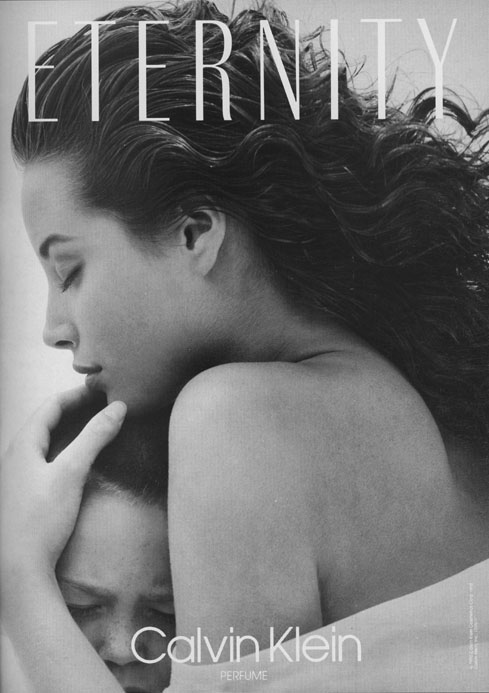
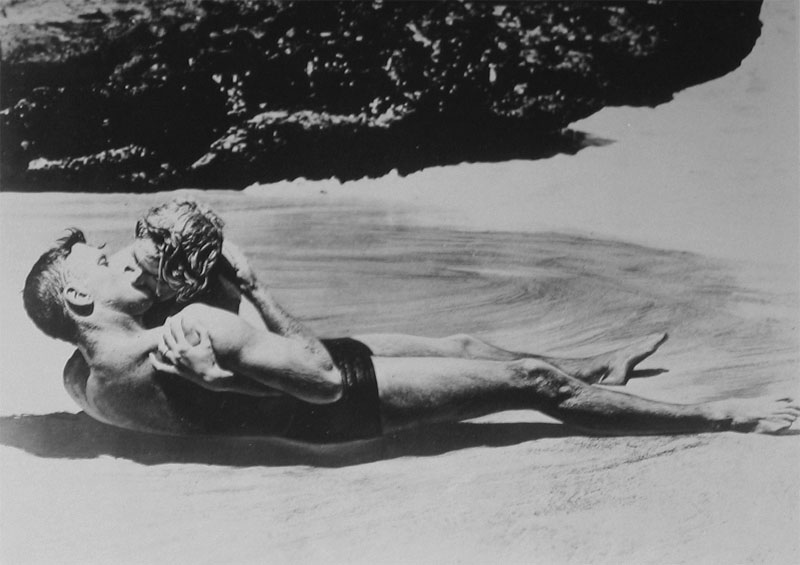
Calvin Klein wanted to capture a romantic vibe after the carnal lust of Obsession and its racy advertising, forseeing the 1990s return to the cocoon and the conservative values of family. Thus an iconic fragrance of the 1990s emerged, advertised in serene scenes of a family by the sea, fronted by Chris Turlington (one of the top 5 supermodels of the era). Was the seascape kissing romantic in that it stirred the unconsious of viewers into reminding them of Deborrah Kerr and Burt Lancaster sharing a passionate salty kiss in From Here to Eternity? Possibly. But the execution was much tamer this time, all preppy and "clean", in tune with the AIDS epidemic which necessitated a (public) cleaning up of one's sexual act.
The name was inspired by the ring of the Windsors, which king Edward VIII had offered to Wallis Simpson, and which Calvin had later bought at an auction for his ~then~ wife Kelly Proctor; it stands as a token of timeless promise of love and immortality: "As long as we're together, time can't touch us" the motto went.

The characteristic peppery heart of Calvin Klein Eternity evoking carnations is dusted with powder (heliotrope, musk) and fresh notes (citrus, greens, lily of the valley), making the fragrance fit for summer or winter, as long as you use it with restraint; it's quite potent! But the overall impression is removed from individual notes: Luca Turin calls it a "loud rose" and he's absolutely right: Eternity takes peppery notes reminiscent of spicy flowers (like carnation) and sprinkles them on top of an intensely soapy rose. In short, if you expect something like the retro Bellodgia by Caron, you will be disappointed.
To really feel the rose beneath the carnation however do an experiment: Take rose-affirmed Paris by YSL (also by Grojsman) and spray one on the one hand, the other on the other. You will feel it all right! After all, rose is Grojsman's favourite flower and she manages to amplify its message in almost everything she touches creating that "cleavage" accord for which she's famous, from Trésor for Lancôme (allied with apricot), Bulgari pour Femme, Nude by Bill Blass, and Jaipur for Boucheron to uber-niche S-perfume 100% Love. "Perfumers have signatures," Mrs. Grojsman said. "You can pick up a fragrance and know who the perfumer is by the way certain ingredients are put together. I'm known for floral accords, bottoms and cleavage."
Memorably, one of the lines I best recall involving the fragrance was featured in an American film involving a gynaecologist molester: his preferred scent on his women victims was Eternity; "it smells of clean sheets" was his (valid) explanation. Creepy...


Eternity proved such a popular concept (it's a best-seller in France of all places!) and name that a legion of flankers (Eternity Moment, Eternity Purple Orchid, Eternity Rose Blush, Eternity Summer and some I might be forgetting right now) have emerged over the years, tweaking the formula to serve the zeitgeist. It's still available (and apparently selling well) in department stores under Coty Prestige.

Notes for Calvin Klein Eternity (1988 original)
Top: Freesia, leafy green accord, citrus oils (mandarin), sage, narcissus, lily
Heart: Rose, violet, lily of the valley, carnation, marigold, apricot, peach
Base: Patchouli, sandalwood, heliotrope, musk

Friday, February 11, 2011

David Yurman The Essence Collection: new fragrances

David Yurman after his first foray in perfume with his eponymous scent is issuing now The Essence Collection, a trio in identical bottles a la niche. The Essence Collection includes three evocative scents, each echoing the artistry of David Yurman’s signature fine jewelry and the emotions associated with three of his favorite gemstones - lustrous pink tourmaline, vivid peridot and glistening citrine. Each Essence is identified with a personal touch from Sybil Yurman—a fluid brushstroke of paint mirroring the gemstone-inspired color.

In the spirit of David Yurman jewelry, The Essence Collection is designed to be worn alone or paired, a layering game that "individualises" the scent for each woman. The Essence Collection has been artfully sculpted for the sense of smell by renowned perfumer of the original David Yurman fragrance, Harry Fremont of Firmenich.

Delicate Essence (Tourmaline): Romantic and feminine, with notes of pink pepper, lotus blossom and sparkling orange.
3.4 fl. oz. Eau de Toilette Spray $85.00

Fresh Essence (Peridot): Crisp and playful, with notes of sparkling apple, cassis, juicy red fruits and fresh greens.
3.4 fl. oz. Eau de Toilette Spray $85.00

Exotic Essence (Citrine): Mysterious and sensual, with notes of sparkling mandarin, casablanca lily, rose petals and exotic woods.
3.4 fl. oz. Eau de Toilette Spray $85.00

The Essence Collection will be available at David Yurman boutiques, www.davidyurman.com, and at Bloomingdale’s in stores next week.

notes, pics via press release

Thursday, February 10, 2011

Perfumery Materials: Violet, Violet Leaf & Ionones

Although often spoken in the same breath when describing fragrance notes pyramids ~standard industry speak for the breakdown of effects in perfume appreciation (a not exactly accurate or realistic means of communicating a scent)~ violet and violet leaves are not interchangeable. Indeed they're quite different, from the romantic, retro powdery feel of violets to the cucumber-metallic-oily effect of violet leaves which adorn not only greener violet scents, but also many masculine colognes.


Violet, has a coy profile in its symbolistic facets: The term "shy violet" is not random; the blossom naturally feels frail and trembling at touch, even though it is sturdy. Thus it traditionally stood for modesty, calmness and sleepiness, traits often associated with females in centuries past. Blue violets signified faithfulness, while white violets were of a happier disposition: they symbolized taking chances. The religious world associates violet with the Passion of Christ and indeed Easter rites in the Mediterranean basin include the use of complementary colors - violet and yellow - symbolic of Lent and the return of spring with its yellow crocuses and daffodils; to witness the two traditional flowers in the Epitaph procession are violets and lilacs, alongside the daffodils narcotizing one's nose in the open air of the evening marches of course: One blossom low-brow and serious like the Holy martyrdom; the other orgiastic like the pagan resurgence of the Dionysian spirit as expressed in the awakening of spring.

A symbol of ancient Athens where it was used in scenting wine and Napoleon Bonaparte’s favorite flower (who preferred it rather than Josephine's beloved musk), violet is a complicated matter in perfumery for two reasons: First, the natural extract of viola odorata (sweet violet/English violet), although it exists, is rarely used for reasons of cost and versatility. Secondly, because there is the distinction between violet flower and violet leaf: the two have a world of difference in terms of odor profile, but that’s not always clear in fragrance descriptions. The flowers have a sweet, powdery ~and when fresh slightly spicy~ note, while the leaf is earthy, green with a cut-grass feel.


The symbolism of violets as emblematic of death at an early age is apparent in the John Everett Millais painting "The Death of Ophelia" and violets which stood for constancy or devotion were traditionally used in mourning. Most people however associate violet with Parma Violets (as reflected in Borsari's Violetta di Parma) a violet-flavoured confectionary manufactured by the Derbyshire-based company Swizzels Matlow; or alternatively, depending on cultural memories, with Violettes de Toulouse, violets preserved by a coating of egg white and crystallised sugar still made commercially at Toulouse, France. (try it in fragrance in Berdoues Violettes de Toulouse). These tender, playful associations might account for the popularity of several sweet florals in the market, especially when coupled with the intensely feminine note of roses producing an almost "makeup" vanity-table effect, such as in L'Arisan Drôle de Rose and F.Malle Lipstick Rose or alternatively allied to modern "berries" tangy notes in Guerlain's Insolence.

In violets along with terpenes, a major component of the scent is a ketone compound called ionone, which temporarily desensitises the receptors in the nose; this prevents any further scent being detected from the flower. (This is why often people complain "I can't smell a thing!", it's not necessarily anosmia, but too much ionones!!) Ionones were first isolated from the Parma violet by Tiemann and Kruger in 1893. Violets naturally include irisone beta, which gives them part of their olfactory profile. The discovery of ionones enabled cheap and extensive production of violet scents, cataclysming the market with inexpensive violet colognes which became au courant in the first throes of the 20th century. The ionones palette ranges from the scent of fresh blossoms to mild woodsy sweet-floral tonalities, while methyl ionones possess a stronger woodsy nuance, similar to iris rhizomes, binding woody and floral notes perfectly such as in the masterful Lutens creations Féminité du Bois and Bois de Violette.
Irone alpha (6-methyl alpha ionone) is a most popular ingredient among ionones in pure form due to its silvery woodiness and its hint of raspberry.
Maurice Roucel was the composer of the mournful, cooly wistful Iris Silver Mist for Lutens focused on the nitrile Irival . Violet is what gives Paris by Yves Saint Laurent its romantic facet beneath the embullient rose, but also the old-world powdery allure beneath the leather in Jolie Madame.

Violet Leaf absolute, on the other hand, smells herbaceous with an oily earthy nuance and naturally includes salicylates [more on which here]. Octin esters and methyl heptin carbonate are used to render the floral green violet leaf "note" with watery accents of melon and cucumber, customary in many modern masculine fragrances and the family of fougères (an aromatic group based on the accord of lavender-coumarin-oakmoss). It also gave the older version of Farhenheit its distinctive feel. If you want to get a good impression of violet leaf in a contemporary composition, smell Eau de Cartier. Several of the greener violet fragrances in the market such asVerte Violette by L’artisan or La Violette by Annick Goutal explore those aspects. The Unicorn Spell by micro-niche brand Les Nez is a peculiar case where violet leaves take on the greeness of just cut husks of harricots verts.
In Dans Tes Bras by F.Malle the tone comes from Iraldeine, a base that helps recreate the freshness of violet flowers, alongside ionones and salicylates. The aromachemical α-n-methyl ionone became commercially available around 1935 in Haarmann & Reimer's Iraldeine Alpha rein and Givaudan's Raldeine A (the main constituent of Fath’s legendary Iris Gris) which Ernest Beaux ~good friends with Leon Givaudan~ is said to have included in 25% concentration in the long-lost Mademoiselle Chanel No.1 from 1942-1946 (as analysed and publicized in 2007 in Perfumer & Flavorist magazine). [Read more on the history of Chanel fragrances issued by Coco Chanel in the 1940s, such as Chanel No.11, No.55 and No.46 in this article]. A modern example of violet leaves in a feminine composition in a very contemporary context is provided by Balenciaga Paris fronted by Charlotte Gainsbourg. A good example of the co-existence of the two elements (violet notes and violet leaves) is presented in a new Marc Jacobs fragrance, Daisy Eau so Fresh.

In short, violets and violet leaves alongside ionones and the other molecules used to produce these nuances, are an integral part of modern perfumery and some of the most recognizable "notes" in fragrances any perfume enthusiast should be familiar with. Why don't you try some of the fragrances listed and see what you feel about them?

Top pic kindly provided by Anya McCoy for my use. The second pic displays "stocks" (which we also call violets in Greek), Matthiola Longipetala. The third pic is Millais' Ophelie via wikimedia commons.

Wednesday, February 9, 2011

Hilde Soliani Conaffeto: fragrance review & draw

If you have dreamed about a fragrance reflecting the endearing and romantic thoughts surrounding a wedding preparation, from the sugared almonds in the little tulle bags as a small treat for anyone attending, down to the orange blossoms garlanding the bride's hair and the groom's boutonnière, then ConAffeto by Hilde Soliani is your answer.


Weddings never fail to tug at my heartstrings, possibly because in the Orthodox tradition they are so impressive and symbolic to savour: the ritualistic engagement of the spouses-to-be resembles a royal crowning, twin-crowns of white blossoms and silver wire (stefana) tied together by a ribbon, are put on their heads and criss-crossed three times to denote the presence of the Holy Triad; the mutual drinking of blessed wine from the same golden chalice a symbol of sharing in their shared from now on life; the ritual cyclical "dance" by the bride and groom of the ceremonial table, to the enthusiastic accompanying throwing of rice mixed with rose petals by the attendees, symbolising their good wishes for fertility and eternal growth. And the small desserts that are given to each guest at the end of the holy mystery and before the wedding reception by the unmarried young women of the extended families in festive attire to whom it's customary to reply "may you wed as well". Oh yes, weddings are a moving event where I come from.

Conaffeto comes from a wordplay on these lovely associations: Con affeto means "with affection" in Italian, but it also resembles the small treat offered at weddings, the sugared almond, called confetto (plural confetti), coined by Monica Polachinni, an Italian American friend of Hilde's. Sugared almonds, according to lore coming from the Arab Al-Razi who invented the recipe, accompany many religious ceremonies in the Christian faith, from baptism to matrimony and it's often with their colour that they carry a special meaning: white for the first wedding, yellow for the (possible) second, pink or blue for christenings, several different colours for the anniversaries of happily-married couples according to years together...
It is with affection for this tradition and a more personal affection that Hilde created the perfume to offer as a custom creation for her friend Danielle's wedding to her Vietnamese fiance. This bespoke perfume of Conaffeto, presented in roll-on oil form, is a floral gourmand, as soft and promising as the nuptials of a couple radiating with happiness at the promise of a sweet life ahead.


Soliani's work in art directing fragrances with caressing, haute gourmand qualities is well documented, from the chocolate-laced fit for Valentine's Day Ciocospezissimo and Ciocorosissimo to the Michelin-star restaurant flavours of Acquiilssssima, Doolciiisssimo, Saaliiisssiimo, Freschiiissimo. Conaffeto is again inspired by foodstuff, but thanks to its restraint and softness, as well as its oil parfum concentration, it remains as fluffy and light as a cloud or a wedding-reception meringue. Simply put, you're met with the aroma of sugar-coated almonds, the crunchy crust a little bit bittersweet, the almond reinforcing the impression and at the background a note of coumarin anchoring it, all put in the context of a linear composition. The floral element (orange blossoms) is subtle, clean, ethereally romantic like two people embarking on one of life's greatest adventures.

Conaffeto isn't yet released outside Italy, but it will soon be. I have a sample for a lucky reader: Please state in the comments what you like (or don't like) in weddings and I will pick a random winner. Draw will close on Sunday midnight.


Related reading on Perfume Shrine: Hilde Soliani news & reviews, Upcoming releases.

By the way for anyone having a sweet tooth, some really grea-tasting confetti from a Greek company: Hatziyannakis. Non affiliated but highly recommended.


Disclosure: A sample was provided by the perfumer.
collage pic of Greek weddings via stigmes.com.gr (click pics to enlarge)

Monday, February 7, 2011

Mapping the Vocabulary of Scent: What Smells like Nail Polish/ Metal/ Sweat/ Horses/ Hairspray/ Burnt Toast/ Baby Powder/Dirty Socks etc?

When testing fragrances, the average consumer is stumped when faced with the ubiquitous list of "fragrance notes" given out by the company. That they do not accurately reflect actual essences or oils entering the composition is a given: Safraleine does not mean anything to the casual buyer, whereas they're familiar with the smell of saffron possibly or the nuance of leather goods, so the "fantasy" copywriting is preferred for all the obvious reasons. But how can in turn the consumer decipher which "notes" appeal or displease in any given perfume thus? "This smells weird and dry, must be the mastic note" comments one, while another says "I sense it as fluffy, could it be the heliotrope?" When in front of an aromatic stanza, one is often at a loss to describe in words the feelings evoked. But the feelings and associations are undeniably there, so an articulate, knowledgeable vocabulary is sorely missing, in part due to the secrecy of the industry and in another due to the limited scope that smell has on our language. Even perfumers themselves could benefit from translating the impressions of people into a concrete transliteration in perfumery terms. In short, which perfumery ingredients give which effect in any given formula? Let's see the most popular queries in alphabetical order and their explanation in a short guide on Perfume Shrine.


Baby powder/talc smell: Usually based on white musks (see this article on classification/perception of musks and that one on synthetic musks) or orange blossom. The latter due to its ubiquitous use in baby products, imparting a feeling of both freshness and tenderness. For reference the actual Johnson's Baby Powder has traditionally relied on the combination of citrus-vanilla-lavender.

Banana note: A natural facet of some white flowers (particularly jasmine sambac or ylang-ylang), when the effect is an unripe, green banana, unpeeled. It's also common when there is a lot of benzyl acetate in the formula, which is in turn naturally found in jasmine, ylang ylang and tobira blossoms.

Band-Aid note: Usually a synthetic "oud/aoudh" base is responsible for this weird, medicinal effect. 

Blood/metallic note: Due to 1-octen-3-one. Has an odour that is a cross between metallic blood and mushroom (see "cepes" notes in perfumery). Blood can be evoked via two aldehydes as well: decanal and nonenal.

Body Odour: see Sweat below

Caramel note: Usually a combination of vanillic notes (real vanilla pod orchid essence or vanillin).

Bad breath note: Usually caused by trimethylamine, fishy in low concentration, ammoniac in higher. (see also Fish note). Sulfurous notes from grapefruit in scent might also "read" as a bad breath note or body odour. Methanethiol (methyl mercaptan) is a constituent of bad breath and has a fecal scent (it is indeed found in flatus and in "asparagus urine", i.e. urine after eating asparagus).

Barnyard note: Usually there is a strong animalic note such as civet/civetone as well as indolic notes via jasmine or other white flowers. The horse note can be produced by presence of p-Cresol (a phenol) as well. A little hay (as in Chergui by Serge Lutens, the closest to natural hay absolute on the market) adds to the impression of a proper barnyard. L'Air de Rien for Miller Harris is a good example of "barnyard" scent via "dirty musks" and animalic notes.

Bread note: Due to 2-Acetyl-1-pyrroline (this is present in pandanus) and to lesser degree 6-Acetyl-2,3,4,5-tetrahydropyridine.

Cabbage note: Due to Methanethiol (also known as methyl mercaptan). Naturally occuring in nuts and cheese.

Cardboard/Old Books note: Due to salycilates (see more info)/"solar notes" and vanilla (the decomposition of wood pupl's lignin ~ a close relative to vanillin~ over time produces that effect natually in old books). Smell Dzing! by L'Artisan Parfumeur.

Cat Pee note: That intense ammoniac spray is due to blackcurrant buds, which have both butyric and sulfuric facets.

Celery note: Due to vertofix, a IFF molecule (methyl cedryl ketone) which smells like vetiver/leathery. It can therefore hide as "vetiver" and musky notes in a fragrance notes pyramid.

Cheese note: Butyric notes, like rancid butter (from βούτυρον/butyron, ie. butter in Greek), coupled with animalic notes such as civet/civetone. Frequent in some intense white florals.

Cotton-Candy (US)/Candyfloss (UK) note: Due to ethylmaltol, as famously used in Angel and Pink Sugar.

Cut grass: A sweet and green scent, usually due to triplal/ligustral (smelling like ligustra leaves) and coumarin (a material naturally found in tonka beans, as well as woodruff, sweet clover and cassia cinnamon). Also cis 3 hexenol smells like grass and is very common.

Curry note: Usually a combination of spices, one of which has to be cumin. It also includes coriander and sometimes "dirty" musks. See L'Autre by Diptyque.

Dentist's office: Cloves, cloves and cloves again! Dentists use clove for its naturally antiseptic properties. Several older Caron fragrances have a clove-y base and most carnation scents are traditionally built on a pepper and clove accord.

Detergent/Fabric Softener note: A great quantity of synthetic musks, especially "white musks" (see index) due to their ubiquitousness in detergents & fabric softeners thanks to their hydrophobicity (i.e. they rinse poorly and thus stay on clothes for long, which is the desired effect by the functional products industry). Cheap ambers such as Cetalox are also used in functional fragrances (i.e detergents), so presence in a fragrance can also give the association of laundry day. If the effect is acrid, it could be also due to dihydromercenol (the ingredient in many fresh aquatic men's colognes, see Davidof's Cool Water for instance) or lily of the valley. Lily of the valley (in the form of synthetics) is commonly used in detergents for the home as well as toilet cleaners thanks to its fresh, clean, green-floral aroma: witness Ajax White Flowers floor cleaner, which replicates the effect to a T.

Doll's Head: A combination of vanillin alongside heliotropin in smaller dose.

Earth (wet) note: This can be due to patchouli being dominant. Also patchouli coupled with oakmoss, but then the note is dryer and more bitter.

Feces/Fecal note: Usually due to indole (a constituent of white flowers, especially jasmine).

Felt-tip pens/markers: This is an effect of p-Cresol. Usually it's done in a "dry" context.

Fish note: There must be a trimethylamine note in there somewhere. At high concentrations, it can be ammoniac-smelling.

Fruity hard candy: Veltol gives a note of berries and caramel-like nuance(it increases the caramel effect and reduces the off cooked butter notes). It increases "creaminess" in both flavours (in lite products especially) and fragrances. You might also find Veltol in chocolate fragrances due to its creaminess.

Fuel oil/diesel: Cis 3 hexenol gives such an effect sometimes, although usually it's producing a green-grassy effect. Consider methyl benzoate as well, as evidenced in the opening of Jicky and Tubéreuse Criminelle.

Garbage note: The sickly sweet smell of rotting flesh/foodstuff is evoked by methyl anthranilate. Naturally found in bergamot, black locust, champaca, gardenia, jasmine, lemon, mandarin, neroli, orange, strawberry, tuberose, wisteria, galangal and ylang ylang. Of course the real corpse smell is due to two other compounds, not used in fragrances, cadaverine and putrescine.

Gas (natural) note: Although gas is primarily constisting of methane, it is the added compound tetrahydrothiophene which gives it its characteristic unpleasant rotten eggs odour.

Glue: This smell is a combination of heliotropin (synthetic heliotrope note with a marzipan facet), coumarin or anisic aldehyde. Styrax also has a faint glue aroma that reads as cinnamon-spicy.

Grape/Kool Aid note: Grape-fruity (concord grapes) is evoked thanks to methyl anthranilate. Dimethyl anthranilate is used to flavour Kool Aid. You might see this masked as a fruity note (berry) in perfumes. Sometimes has musty facets.

Greens bitter: Some pyrazines are responsible: 2-methoxy-3-isobutyl-pyrazine is the main flavour constituent of green bell peppers. Methoxy-methyl-, -ethyl- or-isopropyl-pyrazine increases the potato flavour of a potato salad while 2-methoxy-3-sec.butyl-, 2-methoxy-3-isobutyl- and 2-methoxy-3-isopropyl pyrazine appear in peas.
On the other hand, 2-methoxy-3-sec.butylpyrazine has been isolated from galbanum oil and has its characteristic bitter green odour profile.

Hair (dity) note: The culprit is costus root (do not confuse with cistus labdanum which has a leathery-ambery smell). Now restricted from perfumery, it is quite common in vintage perfumes (see Fille d'Eve by Germaine Cellier for Nina Ricci)

Hairspray note: Usually due to benzyl acetate. Among hairspray brands, some further aromatize their product with other aromata: L'Oreal Elnette hairspray for instance is particularly musky (in a pleasant ~to me at least~way)

Honey note: Either due to natural beeswax absolute in natural perfumery or -more commonly- due to mimosa & cassie absolute as well as cinnamic acid (used in the manufacturing of the methyl, ethyl, and benzyl esters for the perfume industry), which has a floral nuance to its honeyed note. Smell L'Instant by Guerlain in Eau de Parfum.

Horses note: see Barnyard note above

Leeks note: See Cabbage.

Melon/Watermelon note: Usually rendered by the immensely popular in the 1990s Calone aromachemical. (technically: methylbenzodioxepinone) . Unmistakeable, you know it well from Eau d'Issey and Aqua di Gio.

Metal/Cold Air note: Often due to helional, giving an impression of ringing cold air in some Northern steppe. Luca Turin describes it as "sucked silver spoon".

Mold/musty note: Dominant "dusty" variations of patchouli, sometimes coupled with carrot seed (which has a turnip-iris effect by nature). It can also surface in some incense variations with patchouli, such as in Messe de Minuit by Etro. Methyl anthranilate also might play a role, in the context of grape-fruity.

Mushroom note: See also Blood (1-octen-3-one) and look out for it in some gardenia compositions.

Nail polish note: Usually due to benzyl acetate, naturally found in white flowers.

Nail polish remover note: Due to methyl acetate.

"Old-lady" note: Due to powdery notes alongside woody ones or aldehydes (see more on types of aldehydes on this link). Too much iris can also give that effect in certain contexts due to its dryness. This is purely a cultural effect, because these happened to be popular smells in decades past, whose wearers are now "older ladies"! (For this controversial can of worms, read this essay).

Peach: Often due to gamma-Decalactone (referenced as C14 aldehyde, famously featured in Mitsouko). Peachy-apricoty scents can be rendered through jasmolactones too, and are actually preferred due to their fatty-creamy aspect.

Pear drops note (UK boiled sweet): A similar smell is found in ethyl acetate, a very evnescent, low-cost liquid used in perfumes as diluent and a common solvent in nail polish removers and decaffeinated coffee beans & tea leaves. It's worthy of note that it's the most common ester in wine, so the mental pear-wine link aromatically is not without cause.

Play-Doh note: Common lore wants it to be similar to heliotropin/heliotrope notes (affectionately referenced in iconic L'Heure Bleue by Guerlain). Etro's Heliotrope is a good example of this in action. I suggest that the modeling clay note is more wheat-almondy in nuance, a bit like marzipan but saltier, not classic Guerlain. Compare with Hypnotic Poison by Dior or Jaipur by Boucheron. Such a beloved, nostalgic note that it has entered a seperate creation by Demeter, simply called...Play Doh!

Pop-corn note: Due to 6-Acetyl-2,3,4,5-tetrahydropyridine, a common flavour used in pop-corn and tortillas.

Rice steam/basmati rice/jasmine rice note: Rendered through 2-Acetyl-1-pyrroline, a common flavouring in said products.

Rice powder/facial powder note: Often due to iris (either due to natural orris butter or violet-like ionones) as well as mimosa.

Rosy apple note: Due to damascones, materials analogous to ionones (which smell of violet/iris). Smell Knowing by Lauder or Coriandre by Jean Couturier to see them in action.

Tar: Due to phenols. Phenolic smells simply refer to tarry ones! Please note that "birch tar" is the pungent, leathery scent associated with Cuir de Russie type of scents (explanation on what Russian Leather scents are here).

Toast/Burnt note: This is due to pyrazines, compounds present in foodstuffs (see Greens Bitter above). Alkoxy- and/or alkylpyrazines can be added to coffee to increase the roast aroma, as well as other roasted foods (even meat).

Tomato note: Due to triplal (green leafy aroma) being overdosed, also green notes/cis 3 hexenal (similar with grassy greens).

Salty skin: Beautifully rendered through natural ambergris. Nowadays often replaced by synthetics.

Socks (dirty) note: Usually due to the presence of costus. Costus being restricted in current perfumery, this will be less and less a concern. The effect is apparent however in several vintage perfumes.

Suntan oil/tanning lotion/warm sand: If the fragrance or cosmetic has a floral-warm odour like the classic Ambre Solaire, sthis is due to salicylates (see this article for info on salicylates). Ylang ylang naturally contains them. You might also find this effect under "solar notes" in a traditional list of accords. If smelling of coconut, the classic Coppertone smell, it's due to gamma-Nonalactone (aldehyde C18) which is traditionally used in suntan lotions.

Sweat note: Common lore wants cumin to smell like sweat, but this is debateable as attested through research (Sweat has naturally sulphurous compounds, such as garlic, grapefruit and onion). Refer to Barnyard and Socks notes as well.

Urinal cake: Due to dihydromercenol (see also Detergent note).

Urine note: Phenylacetic acid is infamous for smelling like honey in large concentrations and urine in dilution. Miel de Bois by Serge Lutens is derisive for a reason...

Warm milk/warm pudding notes: A combination of vanillic notes, possibly with veltol or ethylmaltol if it reminds one of puddings or desserts off the oven. Saffron and mimosa also have some facets which are reminiscent of these, perhaps due to associations with edible notes.

Wine notes: Since ethyl acetate is the most common ester in wine, its presence in a perfume formula (which is common) evokes a wine-like effect (also see Pear drops). Some rose essences also have wine-y facets; witness Ce Soir ou Jamais by Annick Goutal.


There are also some more abstract effects which are caused by specific ingredients
:
The "nose-hairs burning" effect is often due to synthetic woody-ambers, such as Ambroxan or Karanal, which smell like strong rubbing alcohol when in isolation. The "needles up the nose" effect (very sharp feel) can be due to lots of aldehydes in a very alkaline/soapy context: see White Linen by Lauder for that sharply fresh, sudsy effect. A seeming anaesthetizing of the nose can be due to a preponderance of ionones (violet notes). The too sour, too acid impression can be due to a very citric touch of hesperidic essences (from citrus fruits).
Usually the designation of something as "fresh" is considered a positive one, even though it might not relate to a specifically "fresh" family (such as aqueous/light floral/light fougere/citrus); analogously, "heavy" usually is used to describe a negative effect, again not relative to specific fragrance families but rather to "volume" of perfume, intense projection and radius of evaporation, especially when combined with more potent notes such as lush florals, intense mosses/woods or oriental/resinous notes.

In the end, getting to know the vocabulary of scent not only facilitates a common language reference among fellow fragrance enthusiastcs, but also enriches the experience itself, much like getting to know the parameters of art critique enhances the appreciation of art itself.

If you haven't caught on the Perfumery Definitions series till now, please visit:

Sunday, February 6, 2011

Marc Jacobs Daisy Eau so Fresh: fragrance review

Hearing that Marc Jacobs's latest foray into fragrance, Daisy Eau so Fresh, is directed at a "younger audience", one pauses to wonder if 5-year-olds are in need of a little grooming cologne for when they're going out to the playground to meet their friends. The original Daisy, in the bottle with the white rubber Takashi Murakami daisies, is already the personification of the young & hip bright fruity floral: Nothing earth-shattering, a pleasant smell that stands as the perfect "safe floral" for office wear, casual parties and anytime you just can't be bothered to indulge in the splendor and challenge of niche brands such as Serge Lutens, Amouage or Etat Libre d'Orange. In fact the canon of Marc Jacobs is unchallenging, inoffensive perfumes, with possibly the exception of Bang, an entry reminiscent of more exclusive-niche fragrances. Daisy Eau so Fresh, a flanker fragrance to the original following the success of its antecedant, continues on the same sure path that the rest of the Jacobs bottles are merrily heading with a rather nice twist.


What's that twist? Daisy Eau so Fresh is taking a slightly retro route to do so, contrary to the ad copy ~perpetuated via online media, haven't these people smelled the scent?~ which advertises this as "more fruity, more bubbly, more fun". We're obviously dealing with a marketing emphasis on what sells best (which in itself isn't very promising), because this isn't fruitier than the original, nor is it more "bubbly". On the contrary the fragrance's effect is composed in a roundabout way via the distinctive nostalgic note of violets: lots and lots of green violet and violet leaves (via ionones and methyl octyne carbonate /Nonadienal I'm led to believe). Allied to fresh rosy-berry accents and "clean" musks it is a scent on the cusp of "scrubbed" and pear-liquer-like: its sweetness comes via ways that do not recall foodstuff or lush white flowers.
In fact the formula reminds me quite a bit of the re-orchestration of Givenchy's L'Interdit from 2003 in the rounded shoulders rectangular with the small gold cap (there was another reformulation in 2007); same with the violet leaves heavy Balenciaga Paris from last season: the leitmotif is similar and it's a very pretty idea in the realm of "fresh" or "crisp" in a non-citrusy context that should be easy for spring or summer wear. Sillage and tenacity are average for Eau so Fresh.
If pressed to choose between the original Daisy and this one, I would probably pick Eau so Fresh over it, although you'd have to be quite persistent in your persuasion to begin with.

The company certainly used a bit of fanfare during the press launch: Guests were greeted by a horse named Dotty, proceeding to spend their evening sipping cocktails, eating steak, and listening to a DJ set by Daisy Dares You, all the while surrounded by the sweet aromata of raspberry and lychee. Top model Hannah Holman is the face of Marc Jacobs Daisy's latest advertisement, photographed by Juergen Teller.
The bottle, taller and more rectangular than the original Daisy, with a cluster of 6 rubber daisy petal appliques in white, yellow and pink, is simply adorable in its kitsch-cute way, even for a decided aesthetics cynics such as myself.

Notes for Daisy Eau so Fresh by Marc Jacobs:
Top: grapefruit, green notes, raspberry and pear
Heart: jasmine, rose, violet, litchi and apple blossom
Base: musk, virginia cedar and plum.

Daisy Eau so Fresh hits the US market on February 27th at major department stores in 75ml and 125ml of Eau de Toilette.

pic via allurabeauty

Estee Lauder Wild Elixir: fragrance review

A limited edition from Estée Lauder comes this month in the form of Pure Color Wild Elixir, or for short Wild Elixir, a vibrant floral Eau de Toilette that accompanies their Pure Color make-up line. Even though travel-retail and/or LE fragrances by Lauder (see Bali Dream) are not reserved for their more intuitive compositions (for those one has to look into the Private Collection more upscale line), they do not fail from a technical standpoint: The scents have good sillage and tenacity, they have a concrete idea which they express in a straightforward manner and they provide that feel-good factor which we associate with boarding planes in exotic locales of azure skies which necessitate a big straw hat, even if back home it's pouring madly; or with the easy elegance of clothes hot off the January cruise collections. Wild Elixir is no exception.

Lauder describes the scent thus: "The radiant, free spirit of today's woman with her deep passion for life is captured in a fragrance as expressive, individual and modern as she is. Pure radiance bursts from this vivid creation of genet flowers contrasted against soft, sophisticated amberwood.From the vibrant top notes, to the rich floral middle notes, to the dramatic yet smooth end notes, the feeling is vibrant, luminous and irrepressibly alive".

All you need to know is that Wild Elixir is a light, vivacious floral that doesn't feel "retro", but which isn't vulgary sweet either nor juvenile. The succulent juiciness of mandarin dominates at first, providing the sweet citric touch that reads as instant sunshine in the middle of winter when you're cussing finding your feet buried in snow first thing out of the door. The genet (broom) note provides the essential backdrop of bracken feel that keeps it interesting and contributes to a certain similarity with the juicy brightness of Coach Signature rather than with the serenely deserted landscape of Dior's Dune (which is also based on an interplay of broom and amber). No other flowers are clearly discernible, the notes more a product of imaginative creation than true reflection of essences. The drydown is nothing extraordinary, smooth tactile woody-amber (Lauder excells at this kind of base) but it pleasantly keeps the composition anchored for hours and hours on end, especially for something so bubbly and vividly fresh. In short, they could have done much worse. I predict it will be popular.


Notes for Lauder Wild Elixir:
Top: Mandarin, marigold, purple freesia, violet leaves
Heart: Genet flower (broom), wild gardenia, orris, pink muguet, blue jasmine, waterlily
Base: Amberwood, musk, sandalwood.

Available at the official Lauder site 55$ for 1.7oz Eau de Toilette


Related reading on Perfume Shrine: Lauder news & reviews

By Kilian Arabian Nights "Incense Oud": new fragrance


Periods and continents diverge to give birth to a new oriental collection By Kilian. Kilian Hennesy, grandson of the founder of LVMH and cognac heir, is well known among perfume enthusiasts for his eponymous collection By Kilian which includes such fragrances as the glorious rosy floral of Dangerous Liaisons and the more masculine woody Cruel Intentions or the more extroverted Love, Prelude to Love or Love and Tears.

The “Arabian Nights” is Kilian's newest project, composed of 5 perfumes, 5 olfactive harmonies, all built around essential oils with strong symbolic values from the East: Oud, Rose, Incense, Amber and Musk.
Pure Oud, Rose Oud and Incense Oud are the first stopovers of this olfactive trip, with Incense Oud to come out shortly.

Oud is an extremely rare and precious oil found in Agarwood, the resinous heartwood of the
Aquilaria tree from southeast Asia and is possibly the strongest trend in perfumery in the last two years, mainly thanks to developments in synthetic replications. (You can read a comprehensive article on oud/agarwood on this link on Perfume Shrine). Still some companies use the real stuff to extend the effect.
The natural oil itself is dark in coloration and has a complex scent, being warm and woody, yet strongly animalistic at the same time. In many Middle Eastern countries, Oud is believed to be worth more than its weight in gold. To echo this belief, the Kilian Incense Oud bottle has a gold plaque engraved with the name of the perfume and the box is decorated with a gold plaque on the top.
Incense, a mystical aroma whose smoke was said to be one of the links between mortals and Gods, is combined with oud, giving birth to a fragrance that is mysterious and warm, yet modern.

1.7 oz/50ml PURE OUD spray $ 395
1.7 oz/50ml ROSE OUD spray $ 395
1.7 oz/50ml INCENSE OUD spray $ 395

Points of Sale:
Bergdorf Goodman
, select Saks, Lucky Scent Bar, MiN (and online at BergdorfGoodman.com, Saks.com, luckyscent.com and MiN.com).

some info via press release

Saturday, February 5, 2011

Petite Mort: Parfum d'une Femme by Bertrand Duchaufour for Marc Atlan

Sly advertising that cleverly crosses the lines without vulgar displays is the image that accompanies one of the most provocative concepts in perfumery nowadays: La Petite Mort is of course codename for orgasm...
"Inspired directly by the only bodily fluid secreted solely through desire and brain chemistry, Petite Mort™ (Parfum d'une Femme) embodies the elusive substance that is created by a woman when she is about to climax. Petite mort, little death, total release; beyond a scent, more like a convulsion of the senses, like a hot, gasping breath that penetrates your memories and alters your subconscious".

I can tell that it will create endless discussion on the boundaries (and artfulness) of advertising, just like some of the best examples have in the past.

Bertrand Duchaufour, star perfumer of niche perfumery, collaborated here with Art et Parfum and Kilian Hennesy (of By Kilian fame) for Marc Atlan, creative director & designer issuing this new fragrance under his own name. Duchaufour worked in this no doubt provocative concept like a challenge. Petite Mort’s fragrance exudes an animal carnality with salty notes of sweat and urea. But warm milk, which is supposed to be the scent that the human brain most closely associates with human skin is also featured in the form of Sulfurol. According to the perfumer, certain subtle ingredients in the perfume are discriminatory, and these notes will not be perceived by everyone. He also describes Petite Mort as “aphrodisiacally compelling”.

Only 100 bottles by renowned verreries Pochet (purveyors to Empress Eugénie of France since 1858) will circulate as well as 15 artistic mods for exhibitions. The price of 1000$ for 10ml reflects the exclusive side of the project and allegedly the intensity of concentration (supposedly 100% compound). The scent was introduced at the Elements Showcase in New York on January 30, 2011. (more on that one on these pages shortly!)

More info and availability for purchase (from this coming April onwards) on the official site.

pic via punmiris

Friday, February 4, 2011

Francois Demachy: Perfumer at Parfums Dior & elsewhere (and footnotes on La Collection Couturier Parfumeur)

I was flatteringly asked by an industry magazine to comment on the work of François Demachy, perfumer and artistic director of Parfums Dior, in view of the 2010 re-issue of Diorama for US distribution and the introduction of "La Collection Couturier Parfumeur" this past autumn. The information was conductive to an interview with the perfumer himself, which appeared in this winter's edition of fashion magazine Industrie. In the interest of our readers who do not have access, I'm sharing some of the points discussed in relation to how Demachy's work has evolved at Dior and LVMH over the years, as well as my views on his personal aesthetics, supplemented by short reviews on some of the newer exclusive scents in "La Collection Couturier Parfumeur".
I welcome your own comments and views on the subject!


The first question involved the possibility or not of a clear-cut "signature" in the work of Demachy. Some perfumers who have attained almost a guru status among perfume enthusiasts (I'm thinking Jean Claude Ellena, Christopher Sheldrake et al) have a very specific style which they express through their every project.

Elena Vosnaki: It would be very difficult to ascribe a clear-cut "signature style" to any artist when they're bound by commissions or commercial briefs. The artist has to follow the patron's demands to some degree; also their specifications and range of options in regards to the media available (the budget for ingredients, growers' and labs' options as availability allows, specific range of concept or focus groups etc.). Perfumers who act as art directors naturally have a greater artistic control over the projects they oversee, but it's not 100% free either. While Jean-Claude Ellena enjoys a sort of what seems like unprecedented artistic freedom at Hermès, probably due to his already documented manifesto and Hermès’s lesser financial dependency on the turnover of their perfumes, Dior and Demachy present a different case: Dior Parfums cater for a huge chunk of the LVMH portfolio and therefore there are several considerations when launching a new fragrance.
Having said that, the latest Escale series for Dior as well as a few flankers for Dior’s best-sellers (Miss Dior Chérie L’Eau, J’Adore Eau de Cologne Florale, Dior Homme Cologne, Farhenheit 32) bring on a new clarity to the range which cannot be attributed to anyone else but Demachy. It’s hindsight in a way, as both perfumers see Edmond Roudnitska as their mentor and have been influenced by his restrained style; an observation worth keeping in mind when reviewing all the latest Eaux in the Dior range. So I think that Demachy will crystallize his vision in the coming years, especially if his desire for a more “hand-crafted” feel is (hopefully) sanctioned by LVMH. The increased quality ~amped with more precious naturals~ in J’Adore L’Absolu, as well as the re-issue of ultra-classic Diorama seem to be positive steps in the right direction, which is further honed with his output in La Collection Couturier Parfumeur; especially in New Look 1947, a gorgeous floral with silky aldehydic sprinkling; and Mitzah, a sexy amber focused on the Ambre83 base that flanks resins with labdanum and castoreum, feeling like provocative underpinnings under a structured dress.

Next the discussion touched on Diorama, the re-issue for the American market as contrasted to the former versions.

EV: Diorama is of course one of the “parfums-phares” of Dior and stands among Roudnitska’s work as the summation of his course from the “patisserie” style of Rochas Femme to the more vibrant offerings that followed (Diorella, Dior-Dior etc). It’s absolutely stunning in its vintage form, the fruitiness taking on a burnished, tawny quality half-way between garbage and mouth-watering delicacy, which makes it compelling. The till recently circulating edition in the Paris boutique was very good, but a bit attenuated compared with my vintage specimens. I would be thrilled to have it reconstituted it in its original form, although I’m fearful that first the hawks at Brussels are watching with a stern eye (IFRA restrictions are something that Demachy himself bemoans and admits as being a major obstacle for the old guard) and secondly, it’s not going to be tremendously popular with the general public; but that’s all right, it’s a connoisseur’s fragrance anyway.
[I have reviewed the former exclusive edition on this link and my thoughts on the 2010 Diorama re-release are posted here].


In what has to do with his work at LVMH, Demachy applies some interesting aspects and ingredients to bring on fragrances that will feel contemporary but also quite sensual.

EV: I think Demachy's old-school Grassois romanticism (he was born in Cannes in 1949) coupled with a very clear, a little savage but at the same time “translucent” technique make for this interesting synergy of modern and classic. For instance, his Escale à Portofino is a perfect mélange of a tried & true concept and a contemporary-feeling formula. It smells bright and fresh without evoking a stuffy, obsolete sensibility of “splashing citrusy tonic after shaving”. There’s sensuality and elegance in Portofino, if one looks carefully. The citron essence, specially treated for Dior (they also have 2 varieties of petit-grain reserved for them), is also of interest and I think it constitutes a trend we’ll be seeing more of.
He's quoted to say: “I believe in the virtues of aromacology: a fresh cologne, with Mediterranean accents of citrus fruit and aromatic scents immediately creates a good mood.” It was on that axiom that the exclusive Cologne Royale was built for Dior. On that train of thought, I would love to see him expand and fine-tune his vision of the great “Eau” (If not surpassing the gigantic Eau Sauvage, then offer the feminine suggestion to speak to young women of today); possibly beyond the established Cruise collection of the Escale scents, into a stand-alone major feminine new launch perhaps! Not only a “parenthesis in the world of perfumes” ~as he described his entry for Escale à Portofino~ and certainly a major step beyond the nostalgic Eau de Grasse Impériale composed at his father's apothecary.
And of course, now I have sampled his all too recent work for La Collection Couturier Parfumeur, I can see that the line is clearly destined to include some classics-to-be: Leather Oud is already shaping up to be a cult favourite, exploiting the multiple nuances of agarwood alongside a rough note (leather) that is making a come-back most forcefully along the industry. His pastoral theme of a certain rustic roughness in Granville (also in the Collection Couturier Parfumeur ), as expressed through the use of provencial herbs ~rosemary, thyme, basil~ shows vigour!


Last but not least, Demachy oversees projects ourside Dior as well: The question is whether he infuses them with a personality that is uniquely his own and how does this happen from an aesthetic viewpoint.

EV: I happen to feel that he has an endearing old-fashioned love for the traditional role women designate perfume for: romance! This was also highlighted in some of his work at Chanel where he collaborated since 1977 (albeit a phase shrouded in a little mystery till recently). I will bring a personal experience to illustrate my point: I recall how I was gifted with Diva by Ungaro when I was merely 18 years old by my beau who liked perfumes. Iliterally grew up with chypres, being of Mediterranean descent, so it was a natural for me, but the expansive, rosy-mossy embrace that engulfed me was almost too emotional: I felt that the perfume was speaking words of love, not only because it was offered me by a loved one, but because it was so very romantic and expressive in itself, a little "hit you on the head with sentiment!". When Demachy collaborated at Ungaro with Jacques Polge (officially head perfumer of Chanel for the last 3 decades) for it, they must have dreamt up of a fiesty Italian heroine such as the one in Visconti’s “Il Gatopardo”. Demachy, I feel, likes the gesticulating, expressive style of the Italians and the sunnier disposition of the insular Roman palazzi to the gloom and reserve of steel-skyed Versailles and its plottings.
His Italian predeliction (he is especially simpatico to the Mediterranean climate and loves the cities of Syracuse and Siena) is also showing in some other creations: Aqua di Parma Colonia Intensa, for instance or the reworking of Pucci’s Vivara (2007). It was sad to see the entire Fendi line disappear into thin air nevertheless, his being Palazzo, although certainly no fault of Demachy himself!

Christian Dior La Collection Couturier Parfumer fragrances are circulating in the following sizes in Europe: 150 euros for 125 ml, 225 euros for 250 ml et 330 euros for 450 ml and ONLY in 250ml bottles for the time being in the US.

photos via Dior, punmiris and estheticrfactory.fr

This Month's Popular Posts on Perfume Shrine