Monday, February 21, 2011

Frequent Questions: How to Date Guerlain Parure Bottles

Among the Guerlain fragrances, one of relatively not very old crop (1975) is seriously missed by connoisseurs: Parure, with its golden plummy reprise of what made Mitsouko the monument of beauty that it is. Simply put, Parure is a more wearable, more festive Mitsouko, a fruity chypre in the best possible sense "a wildly original blend of lilac and amber, cyprus and plum blossoms" (as quoted in a 1977 advertisement) and one of the last throes of a lineage which includes such beauties as Rochas Femme and Dior's Diorama. Parure is discontinued due to not conforming with recent standards of alleged allergens in the industry self-regulating body IFRA, according to an interview which the artistic director of maison Guerlain, Sylvaine Delacourte granted to Perfume Shrine in summer 2009. Very much a pity, shooting vintage juice on sale to stratospheric heights and justifiably so: Because Parure not only is lovely to smell, but it also came in some of the most beautiful, unique bottles and packaging in Guerlain history! In the interests of chronologising your bottles (or potential purchases, if you are so lucky as to find any), here is a small guide to Guerlain Parure perfume bottles.


The original edition in extrait de parfum is among the most beautiful specimens of crystal making: a rounded body topped with a crystal cap which reprises the movement of a wave, the whole mounted on a small pedestral in black bakelite engraved Guerlain and housed in a celadon-hued box. Six moulds were made by Pochet et du Courval from March 1975 till September 1981 in the following sizes:
2.3ml mini,
7.5ml/0.25oz,
15ml/0.5oz (with a footing in crystal instead of the black pedestral)
30ml/1oz, 60ml/2oz,
120cc (that's 120ml aprox.; it has no "foot" in crystal and bears 1974 copyright on the box, while it was stopped in October 1980) and a staggering mould for a 1290ml factice.
Saint-Gobin Desjonquères issued a 15ml/0.5oz mould in June 1979, which bears on the bottom in relief "Guerlain Paris Bottle made in France SGD" and the number of the lot.

A contemporary more standard amphora bottle of the extrait de parfum (like the one depicted here) was also in circulation as well as the "umbrella flacon" (see this article), probably aimed at different markets as is usual with a house with so rich a history as Guerlain.

From October 1981, the production of the magnificent Parure extrait "wave" bottle stopped altogether (making the crystal extrait version extremely sought after as a rare collectable). The fragrance was offered instead in standard quadrilobe bottles (which also houses many of the house's extraits to this day, such as Jicky, Nahema, Vol de Nuit etc) in sizes 7.5ml and 15ml. You can see a big picture of it on this article, reviewing a rarer scent in the Guerlain stable, Pour Troubler.
All extrait de parfum (pure parfum) producion in Parure stopped at the end of 1989 and the fragrance circulated in Eau de Toilette concentration (but NOT Parfum de Toilette) thereafter.

Another very rare specimen and sought-after collectable is this design on the right, le flacon strié, as it's called. The rarity is due to it being a limited edition, issued for the Eau de Toilette of only Parure and Chant d'Arômes. This version by Saint-Gobin Desjonquères circulated from March 1994 until August 1995 in only 750.000 bottles for both scents. The box and round sticker label on the bottle are in geometrical patterns of red-orange-terracotta tones for Parure and in pink-yellow-pistachio hues for Chant d'Arômes.

Habit de Fete bottle for Eau de Toilette, far left and far right.

Flacon goutte for 500ml eau de toilette

The more standard bottle for the length of the late 1980s and 1990s in Parure Eau de Toilette and Eau de Parfum was the long refill bottle in the Habit de Fete gold canister with the cut-outs (left and right of the top photo): 50ml for Eau de Parfum and 93ml for Eau de Toilette.
Before that there was the flacon goutte (shaped like a large tear, hence teardrop bottle) with a mushroom-like cap for the Eau de Toilette in the 500ml size for dedicated wearers, depicted directly above. The label is oval with a black background and gold lettering, as you can see.


The final design for Parure comes in the standard "bee bottle" introduced for the rest of the Eau de Toilette range (including Après L'Ondée, Chant d'Aromes, Mouchoir de Monsieur, the Eaux de Cologne such as Impériale, Du Coq and Fleurs de Cedrat) in the early late 1990s. Two versions circulate in this size and style: one reformulated to meet latest requirements till 2009, the other with a shorter ingredients list slightly older. The packaging is otherwise identical.

Guerlain Parure is just one of the vintage scents where knowing the packaging history greatly adds to the better understanding of both scent and the collection value of any bottle.

top pic & goute pic thanks to les-parfums

Sunday, February 20, 2011

Perfume Choices of the Famous: Liv Tyler


According to reportage, the stunning actress - for some years now an ambassadress for Givenchy and the face of the new fragrance Very Irresistible L'Intense - says "she doesn't like to change her fragrance as she wants people to recognise her smell but hates it when the scent is too much".

She's quoted as saying: "I like having one perfume that I wear all the time, so it becomes part of you. When someone remembers your scent, it's incredible. I don't like it when you first spray on a fragrance. It's nice when you've put it on in the morning, then in the evening, you can subtly smell it." [source]
Of course she's quick to point out that the newest Givenchy is her favourite. As if she wouldn't. Doesn't really matter: Liv is lovely whatever she wears.

Saturday, February 19, 2011

Cacharel Anais Anais: fragrance review & history

Who could imagine a block-buster perfume today being promoted through porcelain-skined beauties in soft focus showing no inch of skin beyond their necks set to pre-classical music? And yet Anais Anais, the first perfume by Cacharel (1978), was advertised exactly like that and became THE reference scent for the early 1980s for droves of young women who still reminiscence fondly of it 30 years later. It's also one of the most influential perfumes in history, at least on what concerns marketing success ~a triumph of Annette Louit~ and top-to-bottom design, if not complexity, quality materials or classicism of composition. It didn't possess any of the latter.

Yet it's still featured on the Cacharel website prominently and is up front on perfume counters. For many,
Anais Anais by Cacharel was the first fragrance they got as a gift; or even better the first they cashed out their pocket money for: Its image was youthful from the start. No doubt the deceptively innocent scent, coupled with the dreamy advertisements accounted for that, as did the opaline packaging with the pastel flowers on it and the slightly suggestive name. It was the debate of many, to this day: Was Anais Anais a reference to writer Anais Nin and her ~"forbidden" to the young~ erotic literature, such as Delta of Venus? Or was it a nod to the ancient Persian goddess Anaitis, goddess of fertility? And which was more provocative?

Cacharel was specializing in retro knits at the time and both references for the name were valid enough, although the company always officially went with the latter. The goddess was testament to a peculiar cultural phenomenon on what concerned the position of woman in the zeitgeist: On the one hand Anais Anais with its imagery disrupted the context of feminism in perfume; the complete antithesis of Charlie by Revlon (1973), if you will, where Shelley Hack was dressed in pants skipping off to work or grabbing the bum of a cute guy in the street as an outward manifestation of her desire to be divested of her traditional passive role. These were both youthful fragrances advertised to the young. So what had intervened in those 5 years elapsing to account for such a change? Nothing much. (If you exclude the rush of spicy orientals in the market in the wake of Opium's success). The French aesthetic was always more traditionally feminine than the American one, going for Venus over Diana, and the marketeers soon realized that the beauty industry can't disregard the changes of times, but deep down, it will always depend on the passivity of the consumer into buying "hope in a jar". Perfume is perhaps the most mysterious of all beauty products, ladden with hundreds associations and legion aspirations. It was deemed best to start bouncing the ball back right away... Plus the youth market hadn't been exploited sufficiently (this was back in the 1970s remember) and someone had perceived that the young regarded standard perfume imagery as bourgeois and old-fashioned: they needed their own. Cacharel was extra attentive to grow the market; they put basins in department stores where they encouraged young women to plunge their hands in basins of water, dry them, apply scented cream on them and then finishing off with a spritz of Anais Anais, extoling the virtues of "layering" for a lasting effect. A youth phenomenon was at work.


And Sarah Moon was called for the Anais Anais advertisements: To take shots of women as pale-limped and virginaly innocent as paintings, lily-like, exactly like the opaline bottle and the main core of the fragrance which was built on lilies of the fields. The long limps gained an almost Piero Della Francesca sanctity, the doe-eyed gazes were soft and narcotized, almost. Were they beckoning unto the males watching, inviting by their easy-to -prey-on-passivity and odalisque-style harem numbers? Or were they nuzzling on each other evoking lesbian fantasies? Perhaps the most provocative thing is that the ladies in question all appeared so very.. young; almost under-age! Whatever the intention, the imagery is still memorable: It marks a mental no-mands-land between the advent of feminism in advertising and the regression to conservative values of the 1990s, peppered with some of the issues that still concern those of us who immerse themselves in beauty advertising with a critical eye.

Four perfumers were credited with the creation of Anais Anais jus: Paul Leger, Raymond Chaillan, Roger Pellegrino and Robert Gonnon, working at Firmenich. A surprising fact as the formula isn't complicated or challenging really. The opening is fresh and a little "screechy", a touch
of green galbanum resin felt all the way through the base (galbanum is in fact a base note but it's felt at the top), giving a herbaceous overture that segues into the main attraction: lily of the valley forms the core coupled with another "clean" note, that of orange blossom, sanctified through the wonders of analytical chemistry. White lilies melt as if gaining human form, tender, devoid of their customary spiciness and given a touch of woody dryness. There is a supporting accord of honeysuckle, jasmine and rose, played sourdine; it's not especially felt. The permeating cleanness continues for long before a hint of playful soft leather in the base surfaces alongside indeterminate, powdered woods to give an intriguing twist to the plot: is this an autumnal scent for more mature women, I wonder?
Although I seem to recall the scent of Anais Anais as a little bit more "substantial" in all its softness, there is no major change in its formula last I compared batches, probably because there is not much of allergens-suspect ingredients necessitating restrictions and because hydrocitronellal (lotv note) has been successfuly substituted anyway. It's a pity the parfum concentration has been extinct for some years now, as it played up the autumnal basenotes beautifully.

Notes for Cacharel Anais Anais
Top: Bergamot, galbanum, hyacinth, honeysuckle, orange blossom
Middle: Lily, lily of the valley, rose, ylang-ylang, tuberose, carnation
Base: Cedarwood, sandalwood, amber, oakmoss, incense, vetiver


Sarah Moon photography via weheartit.com and thefashionspot.com

The winner of the draw...

...for the Conaffetto sample is *Jen. Congrats and please email me with your particulars using the email contact on Profile or About page, so I can get this out to you soon.

Thanks to everyone for the participation and till the next one!

Friday, February 18, 2011

Sunny Fragrances to Beat the Winter Blues

There are some occasions in the lagging days of winter, eternally stuck someplace between middle & end of February, when the snow keeps piling up at the front windows and the birds fly down-spin over the yard, which can exasperate even the bravest of brave souls. Although my own native winters are mild & sunny, with only the occasional snowfall, white flakes not sturdy enough to pile up and withstand the coming out of the sun the next day, every time I have been away from home into a northern European country or in the windy winters of Down Under beside the lapping of the cold ocean, I got a taste for what it must feel like to always be cold, always rubbing one's nose when outside to stop it from getting numb.

The scented world around seems sleeping, with the indoor smells gaining momentum, but perfume can provide an intentional, on demand change of one's landscape: How exquisite a pearly aldehydic floral seems on an ice-cold day and how bright & dreamy does a floriental, full of the sunny rays that warmed the petals of its tropical flowers...

My picks for instilling a sunny disposition and banish those winter blahs comprise a list of perfumes which are noted for their optimism, sheer joie de vivre, indulgent nature and easy wearing; in two words, uncomplicated happiness! Fragrances to remind you of the coming of spring and to put a spring in your (still mutton-wearing) step! After all, in Turkish tradition the end of February marks the end of winter's cemre: Cemre are 3 fireballs coming from heavens to warm the earth for the coming of spring; the first appears on February 19-20, the second between February 26-27 and the third falls to ground on 5-6 March...Spring is just round the corner!
And if you're gifting someone to cheer them up, consider a bouquet of chocolate hearts for a perfect gift hamper accompanied with an elegant floral perfume for a striking impression.

10 Fragrances to Beat the Winter Blues for Men/Women:

Patricia de Nicolai Le Temps d'une Fête
The perfect hyacinth-ladden green floral to evoke spring, full of crushed leaves & grass; a fragrance so beautiful and cheerful that it will make you spin around and around humming Mendelssohn's Spring Song even when getting down the Christmas decorations.

Ayala Moriel Les Nuages de Joie Jaune
Described as "drifting in yellow clouds of happiness", this is an all-natural soliflore fragrance built on the yellow pom-poms of mimosa and the honeyed goodness of cassie. As light as air and as joyful as the first bright, sunny day in late February. [availability]

Annick Goutal Songes
Someplace in the tropics, languorous women with Gaugin-esque physiques pick up cananga odorata (ylang ylang blossoms) to render their sunny essence which finds its way inside this summery potion of liquid sunshine. A floriental full of the suntan and solar notes of salicylates, fanned on a vanillic and woody base.

Guerlain Aqua Allegoria Mandarine Basilic
These succulent Mediterranean flavours, combining almost as in a fruit salad, benefit from the spicy zing of the basil note. An easy, piquant scent which lifts the mood anytime.

Profumum Victrix
The Latin sounding name hides a masculine cologne of earth and wind, where the laurel, the greens and the coriander conspire to give notions of open, endless prairies under a dog-toothed sun.

Molinard de Molinard
Fruity floral in the best possible sense. If you like Amazone and just didn't know where to look to to find a similar fragrance, look no further. This is has the happy ambience of a warm summer evening spent at an outdoors cinema in Sicily or a Greek island, all paved with gravel, with thick jasmine & honeysuckle vines climbing its walls, watching Cinema Paradiso.


Hermès Concentrée d'Orange Verte
This lime-laced cologne is simply the best masculine/unisex cologne to lift a lagging mood or a weary spirit. The hesperidic touch is enough to get you out of bed as sure as a good Robusta.

Patou Câline
The greenly fresh aldehydic sophistication and malleable primness of Patou’s Câline remind me of Audrey Hepburn in Sabrina, after her European trip in which she becomes a proper “lady”, almost unrecognizable to those who knew her as merely the chauffer’s daughter to the rich family. [Full review here.]

Lancôme Miracle So Magic
A surprising entry in the Miracle flankers stable, this is composed by Annick Menardo and although it diverts from her smoky, dark path, it bears a remarkable affability without insipidness: the green sweet smell of clover fields opens up on an endless vista in front of you as wild-flowers zoom into focus. Just lovely!

Hermès Iris Ukiyoé
Its detractors call it "Yuck! Away!" but don't let this parody on the Japanese-alluding name deter you. Notes of an aqueous hydrangea and a lightly spicy grape-like accent bring forth the fantasy of the iris flower, instead of the familiar rooty-violety root. Spring-like! [Full review here.]

And of course anticipating some of the upcoming fragrances for spring makes one dream a little bit and withstand the last throes of cold better. Catch them up here!

And you? What are your favourite fragrances to come out of hibernation? Tell me in the comments.


Spring Song by Felix Mendelssohn from "Lieder Ohne Worte".
Painting "The Promise of Spring" by Lawrence Alma-Tadema.
Molinard pic via Perfumes.bighouse.blogspot.com. Goutal bottle via thefragrantelf.livejournal.com

Thursday, February 17, 2011

Chanel Gardenia vintage vs. modern Les Exclusifs Gardenia: fragrance review & history

The original Gardénia, issued by Chanel in 1925 and composed by legendary perfumer Ernest Beaux who created all the early opi/opera of Chanel, was built on a fashion premise: The deco motifs of the 1920s exalted the almost cubist arrangement of flower petals, resulting in designs which were transported into impressive jewellery. Gardénia was not conceived as, nor was it meant to be, a gardenia soliflore, although the heavy-smelling blossom was picked thanks to its optical resemblance to Mademoiselle Chanel's favourite flower: the camelia, which doesn't hold a scent. The name in reality derives from the English word "garden" (it's jardin in French): a popular reference of the times, especially if we recall the Shalimar story and the gardens of Lahore that made the imagination run wild. That was then.

But gardenia fragrances in particular re-entered the consciousness of the public with a vengeance in the next decade, the 1930s, in a different manner. This was a time of financial difficulties and a more conservative cultural milieu, when every company was launching or re-issuing their own gardenia fragrance; advertising them as a return to neo-romanticism, the gardenia boutonnières of Edwardian dandies and the gardens in the South of France which provided welcome escapism. Indeed an American advertisement for Chanel Gardénia mentions how it's meant to evoke romantic gardens at the Riviera and tags it as a youthful fragrance. [Chanel is no stranger to capitalizing on advertising to promote specific perceptions of their products, as it famously did with No.5.]
It was 1936 after all when the hit song "These Foolish Things (Remind Me of You)" by Eric Maschwitz & Jack Starchey included the infamous lyric "gardenia perfume lingering on a pillow"...alongside "an airplane ticket to romantic places". Is it any wonder that in the economically "tough" decade of the 1970s Brian Ferry & Roxy Music chose to bring this song back doing their own cover on it (1973)? Chanel would eventually bring their Gardénia back from the dead too; but almost two decades later. And as recently as the end of the 2000s yet again, this time in their boutique line Les Exclusifs where's it's still available.

Olfactorily, the two versions cannot be any more different, providing a valuable history lesson for any inquisitive perfume lover:

The vintage Chanel Gardénia was composed on a narcissus base with a green accent of styrallyl acetate; a freshly green note, naturally present in budding gardenias and a very popular inclusion in many classic floral chypres: It provides the gardenia greeness in the heart which compliments the mossiness of the background, from Miss Dior to Ma Griffe. The trick of composing a "gardenia chord" instead of using an extract from nature was necessitated by technical complications: No essence could be rendered (till very, very recently in fact and then only in some extremely limited distribution niche fragrances). The gardenia in the hands of Chanel is oscillating between green and creamy, as it's allied to other white florals with a powdery veil.
The top note of the vintage Gardénia however is surprising in that it's built on a violet accent, composed through octin and heptin methyl carbonate. The progression from the sweeter violet to the feminine floral harmony in the heart, featuring natural jasmine, makes for a rounder experience with woodier base notes recalling those in Chanel's own Bois des Îles or even Coty's Imprevu, with a spicy whiff of vetiver lingering.
The vintage came in extrait de parfum (a very round and feminine smell) and later Eau de Toilette in the standard square bottles with the round black screw-on cap. Opening one, made me realise how different the perceptions of a floral were in those eras back contrasted with today: Although I can feel the delicate rendering of petals, there is no immediate "department-store atmosphere" of a hundred florals sprayed simultaneously into the air. Drop by drop, it's silky and polished, like a strand of patina rose pearls in slightly differing diameter.

The original version of Gardenia circulated well into the 1950s, but it disappeared at some point when other Chanel fragrances such as No.19 and Cristalle entered the scene. Sometimes the labels did not have the French accent aigu for the American market.
An effort was made to bring it back alongside the more faithfully rendered classics Cuir de Russie and Bois des Iles in the Chanel "Rue Cambon" exclusive boutique circuit at the cusp of the 1990s: Regrettably, it was the least resistant link in the chain, accounting for a rather destitute white floral. The bottle in extrait was rectangular with a white label like standard Chanel extraits (depicted) and the colour of the juice a light yellow. There was also a limited edition Eau de Toilette in a rectangular bottle edged in gold, with white label and white cap in the 1990s (shown on the right).


The modern version of Gardénia as part of Chanel Les Exclusifs more upscale line, reworked by Jacques Polge, conforms to the latest regulations and changing tastes. Thus it is comparatively much thinner, stretched to its limit, based on a standard white floral chord with fresh & green jasmine/hedione, "clean" orange blossom cologne-ish notes and just a smidgen of tuberose (and absolutely no gardenia whatsoever). A delicate vanilla base is the only other detectable note, very light and soft without much sweetness. The fragrance's popularity and reception is no doubt accounted by its transparent and easy demeanor which lends itself easily to any wearer. There is a young, ice-princess vibe about it, rather classy in its sex-denying way.

It leaves something to be desired in fulfilling a powerful romantic imagery and rather much in providing an avant-garde entry in the field of white florals (which it could have tried if it wanted to); but its wearability provides options for casual & office wearing, which is more than can be said for some of the more sumptuous and demanding vintages. Among Les Exclusifs, in Eau de Toilette concentration with an even paler colour of juice than before, Gardénia is also one of the most fleeting, making for a brief experience that needs to be constantly renewed.

Notes for Chanel Gardénia: jasmine, gardenia, orange blossom, tuberose, clove, sage, pimento, musk, patchouli, sandalwood and vetiver.


Ella Fitzerald sings These Foolish Things


And Brian Ferry reprises it in his own innimitable style in a rare 1974 video.

pic of vintage parfum via musclecars.net. Ebay & stock bottle photos. Pearl necklace & gardenia extrait bottle via the Romantic Query Letter.

Wednesday, February 16, 2011

By Kilian Incense Oud: fragrance review

Nothing is more alluring than the forbidden and at a time when the Muslim world appears as West's "enemy" in the zeitgeist, the surge for Arabian-inspired perfumes is gaining momentum thanks to that very axiom. Incense Oud by Kilian is one member of the cast in this multi-character play where prestige and polish are given to niche lines through the claim on age-old materials, such as oud/agarwood and incense; but it's not just a supporting player.

Incense Oud managed to make me notice ~my nose has become seriously jaded with oud-claiming notes in just about every price-point in the market!~ and that's no small feat. Is it because oud has become a play on perception since the perfume doesn't -apparently- contain any? Smoother than the Montale aoud scents, which possess that "Band-Aid note" so distinctly and which announce their presence from five blocks away, the Kilian fragrance feels very wearable and with its elegant eloqution of Eastern materials manages to smell at once mysterious and meditative. It's an "oud fragrance" for non-oud-lovers, but it doesn't betray the promise of Middle Eastern atmosphere.

To an audience of men and women tired of the pop celebritoids popping up through reality TV and one-hit wonders, a media plate brimming with upstarts ready to forsake their panties at the drop of a nickel and eager to leak their own sex video tapes online, a veiled lady or a tanned Arabian prince half hidden under a djelaba look not only exotic, but infinitely classy. When on the other hand you have a Colossus such as LVMH, the Group behind the By Kilian brand (indeed Kilian Hennesy is the heir to the throne of the cognac empire) supporting and pushing the Arabian Scent Concept to anyone willing to look beyond Walmart, you can bet you have a sizzling hot trend on your hands!

As announced, By Kilian Incense Oud is the newest installation to the "Arabian Nights" collection. It is a dark and well balanced blend of frankincense & woods (cedar, patchouli and sandalwood get amped by the naturally leathery accents of cistus labdanum and the murkiness of a little oakmoss) evoking the "impression" of oud. The patchouli gets a boozy, almost licoriced facet, it's soft and quite delicious.
The first impression you get from Incense Oud is terpenes-rich frankincense, the kind you smell in Catholic churches (the Roman Catholic Church sources its supplies from Somalia); in fact the brand claims it makes a quart of the total formula! It doesn't present itself as a hard-core incense fragrance nevertheless and there is no smoky trail, but rather a resinous quality about it. The naturally citric facets of this ancient gum are reinforced by complimentary notes (methyl pamplemouse for one, which is grapefruit-like). The natural pairing of oud on the other hand is traditionally rose, but you can't quite pinpoint this is as rosy. Rose is smoothly blended with the patchouli and therefore nothing like you'd meet at the florist's or ~heaven forbid!~ in a toilet freshener. Think of the treatment of rose in Voleur de Roses in L'Artisan for that segment in the fragrance, a dark rose unfurling its petals under a moonless sky.
The lasting impression is patchouli with a hint of myrrh to reinforce the sweetness in Incense Oud: the longer the perfume stays on skin, the more pronounced the sweet leaves become. Of course, patchouli is to the 2000s what hair mousse was to the 1980s: there's simply no escaping it. Not that I particularly mind.

Sidonie Lancesseur had composed the oud-themed Cruel Intentions, as well as Straight to Heaven, for the brand’s introductory "L’Oeuvre Noire" series. The rest were composed by Calice Becker. Although the info on shopping sites presents Lancesseur as the creator of this scent as well, the Kilian press says that Becker is the real creator. Here she was presented ~oddly~ with the challenge of composing an oud-themed fragrance without including the essence or the synth. I seem to think there's a smidge of it there, but I could just be showing my contrarian colours!

The whys of such a decision not to advertise as it containing oud, when the name alludes otherwise, could be seen in diverging interpretations: It could be that the challenge is a plea to people's intelligence and consequently perfume aficionados' increasing cynicism: "You distrust oud as a mentioned ingredient, so here, we're offering you one which doesn't lie in its notes about what it contains or not". Or it could be interpreted differently, along the lines that since oud is the material du jour, it doesn't matter whether or not there is any included; "as long as it's mentioned in the name, people will try it and buy it". Of course I am not professing any of the two versions as truer than the other; I'm just noticing things!
Kilian offers cardamom as a featured note too (probably because the inclusion of cardamom pods are a time-honoured tradition in the preparation of delicious Arabian coffee and is too good a reference to eschew), but it's not as discernible as in Cartier's Déclaration for instance; it doesn't form a major part of the experience.
Simply put, if you like frankincense and patchouli-rose accords, you stand good chances to like Incense Oud, because it lives up to the former (being the first half of its name) and offers a polished interpretation of the later. The sillage is medium and tenacity is very good. It's a sneaky scent I found, growing on you upon consequent wearings.

Notes for Incense Oud By Kilian:
Guatemala cardamom, pink pepper, Turkish rose, Egyptian geranium, methyl pamplemousse, Virginia cedarwood, Indonesian patchouli, Indian papyrus, Somalia incense (oil and absolute), sandalwood, Macedonian oakmoss, Spanish cistus labdanum, musks.


Available in 50ml bottles for $395 (ouch!!) at Luckyscent et al. Smart tip: go for the refills for same quantity for 175$ (i.e. perfect for splitting).

Disclosure: I was sent a sample vial for reviewing purposes. Pic was sent to me by email unaccredited.

Tuesday, February 15, 2011

Serge Lutens Jeux de Peau: fragrance review & draw

Horace had written* referring to his diet: "Me pascunt olivae, me cichorea, me malvae" ("As for me, olives, chicory, and mallows provide sustenance"). I don't know if I could supress my gluttony for "all the perfumes of Arabia" into a diet of only a few well-chosen ones, but Serge Lutens has a way into tempting me. Jeux de Peau, his newest (upcoming for the US) launch, is no exception. With vivid contrasts and a fascinating plot via Daedalean alleyways, it proves that the Master is still producing fragrances that can surprise and excite.


Jeux de Peau
(pronounced Zø de POH) aka Skin Games, a fragrance for both genders, was supposed to smell of buttered toast, recalling Serge's quick run to the boulangerie across the road to pick up a baguette: "It gets me back to the 'don't forget to pick up the bread on the way back from school!' At the boulangerie at the end of the road, its captivating odour and its blond and warm light, a golden moment..." says Serge. Well, naughty, naughty Uncle, this is not what one would expect! The mercurial Serge actually hints at the humanity of the fragrance when he provocatively says "Eat, for this is my body"; especially if we consider that some human skins do smell like bread, the "dough" impression being a Ph variance.

Not that that this cryptic game would be unusual for any fan; in fact the fascination with the newest Lutensian opus comes exactly by its surprising character, at once a part of the Lutens-Sheldrake canon and a little apart; it's new and at the same time familiar, like seeing the photographs of antecedants and trying to pinpoint what part of the genetic roll of dice resulted in similarities with one's own offspring.
Starting to break down the composition of Jeux de Peau much talk has been conducted about the "burnt" note of pyrazines [see this lexicon on perfume effects according to notes/ingredients for definition] but I remain sceptical: Jeux de Peau doesn't really smell burnt or heavily roasted; more milky-spicy-golden in the sandalwood goodness that was Santal Blanc. It has a pronounced celery-pepper opening note, much like Chypre Rouge did, a trait that will certainly prove controversial, coupled with delectable milky-buttery notes which almost melt with pleasure on skin. The celery effect ~celery seeds were a common element in Mediaeval French cooking~ lasts for only about 5 minutes seguing into the main course: the buttery accords, alongside a distinctive, very pleasant chicory note.
Chicory, a bitterish-spicy smell, is a profoundly clever "note", if I am correct in surmissing it was the centre of the Jeux de Peau creation all along: It was substituting coffee in WWII, which might account for some of the memories of Serge, but it also evokes beer because producers add some in their stouts to lend flavour. Beer is so close to bread in olfactory terms that it's enough to put some on a pot on the stove for your guests to be fooled into thinking you're baking your own bread! (Not that you'd resort to such tricks, or would you?) Plus chicory root is 20% inulin which is very similar to starch. So the bread connection is there all right!
Immortelle/helichrysum notes (caramelic maple & spicy fenugreek facets) are allied to the familiar candied-dried fruits (apricot mainly, simply lovely!) which perfumer Chris Sheldrake has been respinning in novel and delecious combinations for Lutens ever since the inauguration of the Palais Royal niche line in 1992. This complex stage in Jeux de Peau by Lutens is sustained for a long, long time; it reminds me of rich Byzantine mosaics; tiny tesserae of glazed material surfacing and receding according to the angle from which you're viewing it.


If you like the core accords of Féminité du Bois or Boxeuses, you will probably detect them easily in Jeux de Peau. But the two diverge in other ways: there's no familiar plum, not much cedar, nor leather (as in the case of Boxeuses), while we can see that wheat & barley are evoked throughout that warm "gourmand" woody. If Serge hadn't mentioned he was inspired from his forays to the baker's clutching the baguette for home, we wouldn't be so insistent on searching for toast; a whiff of Crusader's pain au four it is and delectably so I might add.

If you're wondering if Jeux de Peau would suit you, apart from the wise advice I can offer to always sample a Lutens any fragrance ~just in case~ I can suggest that if you're a lover of other intellectual oriental woodies such as Like This by Etat Libre d'Orange or Tea for Two by L'Artisan, you have high chances of liking this one very much as well. It's rather odd that Jeux de Peau launches in spring, when it's the sort of snuggly fragrance you'd want to put on while wrapped in a cashmere blanket watching nonchalantly the logs in the fireplace change colours from brown to vermillon to bright red to ashen, but Lutensian fans are not very season-specific anyway.

A sample of the upcoming Jeux de Peau will be given away to a reader. State in the comments what is your most fragrant memory from childhood not involving actual fine fragrance and I will pick a random winner. Draw is open till Friday midnight.

Jeux de Peau belonging to the export range of oblong bottles is out in France as we speak (79 euros for 50ml Eau de Parfum), but will launch internationally on March 1st. The Perfume Shoppe in Canada is already taking pre-orders.

*Odes 31, ver 15, ca 30 BC


An intelligent essay on the scent, in French, on Ambre Gris. Photograph in black & white Le Petit Parisien by Willie Ronis via Art is not Dead. Bottle pic via duftarchiv.de
Disclosure: Initial sample was kindly procured by my reader Emanuella. Another sample was later sent by Lutens as part of their mailout, so that is given away to the readers.

Monday, February 14, 2011

Fragrant Offerings (and more) for Valentine's Day

Beyond the juvenile "I love you" teddy-bears, the kitchy sentimental magnets and Hallmark postcards, Valentine's Day is just another chance to celebrate that which should be celebrated each day of the year: true love. And what is love but that force that surpasses all obstacles, all hindrances, to make possible the impossible?
In that vein and collaborating with The Non Blonde, my friend in arms Gaia, today we embark on a small homage to the world's most powerful god of them all: Eros or Cupid!
My first acquaintance with Scarborough Fair, the 16th century folk love ballad, had been in the version (immortally) sung by Simon & Garfunkel (contrapuncted with Canticle, a song about a soldier) in the iconic film of the 1960s The Graduate. Who can forget it, put into that memorable segment of chasing after phantoms? Yet other versions might focus our attention more to one "fragrant" passage in it, namely the line "parsley, sage, rosemary, thyme" which gets told and retold throughout.
More than meets the eye, Scarborough Fair talks about Love Magick. It talks about a couple who have been estranged: She has left him, he yearns for her and to rekindle their love, all delivered in a lengthy message over the song ("remember me to one who lives there, for once she was a true love of mine"), they exchange challenges consisting of impossible tasks which would prove they still have love for each other: she has to sew a cambric shirt with no seams or needle work, then wash it in a dry well, or find an acre of land between the sea and sand. Is it a reaffirmation of his pain or can love do the impossible?


Amy Nuttall sings Scarborough Fair.

The fragrant part of Scarborough Fair is indeed full of symbolism:

Thyme: Girls once used thyme sprigs in ceremonies to discover the identity of their true loves. A more upscale lady of Medieval times would embroider a flowering thyme sprig along with a visiting bee as a token to be given to a favored knight. A woman wearing thyme was once held to be irresistable.

Sage: Sage was once used to help childless couples conceive, and is associated with wisdom and longevity in plant lore. It was also used magically to honor weddings and to ensure domestic harmony.

Rosemary: Was once held to represent love and faithfulness. The plant was used in wedding ceremonies in place of rings as a sign of fidelity, and carried by newlyweds and wedding guests as a charm for fertility. But it also has the meaning of remembrance, as Shakespeare noted in Hamlet 'there's rosemary for remembrance.' Often used in love potions, it is also said to attract elves.

Parsley: It was once believed that only witches and pregnant women could grow this herb--Sow parsley, sow babes, was an old expression. The herb has been associated with witchcraft in England and also with death since ancient times. But more importantly, it is said to provoke lust and love.

Additionally, these herbs have long stood as "messages" to higher ends: Thyme stands for devotion, sage implies dependancy, rosemary (as Ophelia well knew) stands for remembrance, while parsley denotes a desire to procreate with said partner.
Keeping in mind these fragrant succulent herbs enter into many a delicious recipe (or even a scented herbal tea which lovers can share), perhaps the modern herbalism could recreate a powerful love potion, not only for Valentine's Day but for every day!
[source]

Music takes into other places as well, where the impossible is taking shape:


Greek-cypriot singer Alkinoos Ioannidis sings "Whatever love dreams".

"Whatever love dreams,
life lets them stay dreams.
But whoever falls in love
turns pain into a prayer,
turns the kiss into a boat
and leaves abroad..."


Extreme sing beautifully "More than Words".

True love is nevertheless often denied...due to inexperience. Or supressed manners. As in Lucy's and the reverent's case in E.M. Forster's A Room with a View (1985) where the possible becomes impossible for no apparent reason at all...until it dawns on her in the end.


Or it can be denied because it's just seems wrong. When it's possibly the only right thing in a messy situation.
Clip from The Priest (1994): One of the most passionate kissing scenes I have ever seen.


My own perfume preferences for Valentine's Day wearing?
Grand Amour by Annick Goutal: Because "love is everything" and he never fails to notice.
Passion by Annick Goutal : Because he loves it so...
Molinard de Molinard : Because this was his first fragrant gift to me and it holds precious memories.
Boxeuses by Serge Lutens : Because it's so darn sexy!
Amaranthine by Penhaligon's : Because a little skank never hurt no relationship.
Kiki by Vero Profumo : Because it's the perfect "morning after" eating-croissants-in-bed scent.


Hope your Valentine's Day is filled with passion and true-felt, beyond-the-commercial feelings!
Don't forget to visit Gaia's blog to read her own musings.

Saturday, February 12, 2011

Calvin Klein Eternity (1988 original): fragrance review

Think of 1980s perfumes and think of today: See a difference? A staggering 11.7% ratio of Iso-E Super (a synthetic abstract woody note) ensures that 1988-issued Eternity by the-then-Calvin-Klein-controlled house was on the vanguard of something that would be exploited to full effect several years later. It also justfies why Eternity doesn't exactly smell like Eternity any more, as Iso-E Super concentrations have been toned down in recent perfumery restrictions.
Sophia Grojsman, the renowned perfumer behind this, is no shy violet when coming to streamlining a formula down to a few core accords & ingredients which give a pronounced effect: Tonalide and Galaxolide (both synthetic musks) are also overdosed, and her other best-selling opus, Trésor for Lancôme, contains a huge amount of Galaxolide, accounting for the phenomenal tenacity (Synthetic musks don't budge off for days on end).

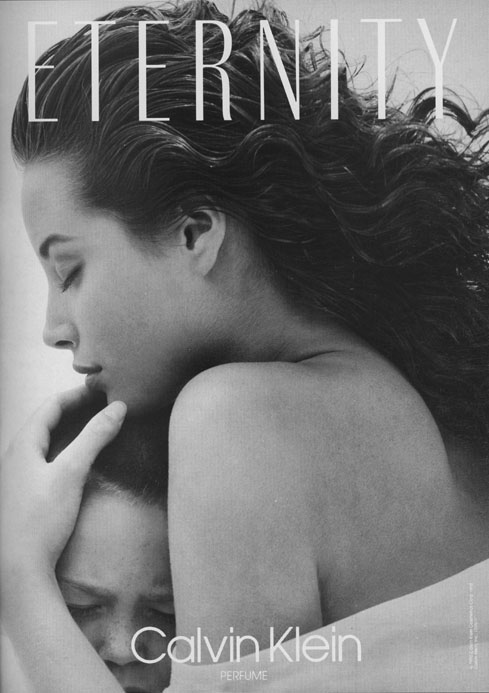
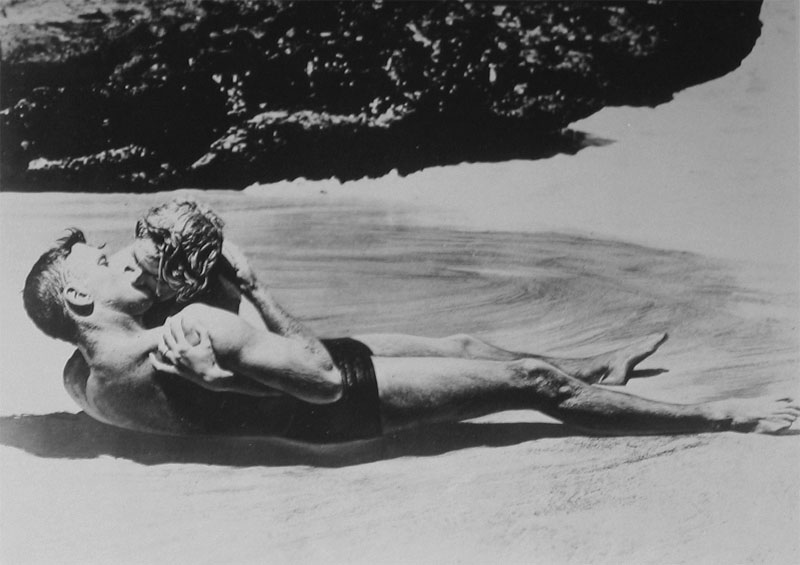
Calvin Klein wanted to capture a romantic vibe after the carnal lust of Obsession and its racy advertising, forseeing the 1990s return to the cocoon and the conservative values of family. Thus an iconic fragrance of the 1990s emerged, advertised in serene scenes of a family by the sea, fronted by Chris Turlington (one of the top 5 supermodels of the era). Was the seascape kissing romantic in that it stirred the unconsious of viewers into reminding them of Deborrah Kerr and Burt Lancaster sharing a passionate salty kiss in From Here to Eternity? Possibly. But the execution was much tamer this time, all preppy and "clean", in tune with the AIDS epidemic which necessitated a (public) cleaning up of one's sexual act.
The name was inspired by the ring of the Windsors, which king Edward VIII had offered to Wallis Simpson, and which Calvin had later bought at an auction for his ~then~ wife Kelly Proctor; it stands as a token of timeless promise of love and immortality: "As long as we're together, time can't touch us" the motto went.

The characteristic peppery heart of Calvin Klein Eternity evoking carnations is dusted with powder (heliotrope, musk) and fresh notes (citrus, greens, lily of the valley), making the fragrance fit for summer or winter, as long as you use it with restraint; it's quite potent! But the overall impression is removed from individual notes: Luca Turin calls it a "loud rose" and he's absolutely right: Eternity takes peppery notes reminiscent of spicy flowers (like carnation) and sprinkles them on top of an intensely soapy rose. In short, if you expect something like the retro Bellodgia by Caron, you will be disappointed.
To really feel the rose beneath the carnation however do an experiment: Take rose-affirmed Paris by YSL (also by Grojsman) and spray one on the one hand, the other on the other. You will feel it all right! After all, rose is Grojsman's favourite flower and she manages to amplify its message in almost everything she touches creating that "cleavage" accord for which she's famous, from Trésor for Lancôme (allied with apricot), Bulgari pour Femme, Nude by Bill Blass, and Jaipur for Boucheron to uber-niche S-perfume 100% Love. "Perfumers have signatures," Mrs. Grojsman said. "You can pick up a fragrance and know who the perfumer is by the way certain ingredients are put together. I'm known for floral accords, bottoms and cleavage."
Memorably, one of the lines I best recall involving the fragrance was featured in an American film involving a gynaecologist molester: his preferred scent on his women victims was Eternity; "it smells of clean sheets" was his (valid) explanation. Creepy...


Eternity proved such a popular concept (it's a best-seller in France of all places!) and name that a legion of flankers (Eternity Moment, Eternity Purple Orchid, Eternity Rose Blush, Eternity Summer and some I might be forgetting right now) have emerged over the years, tweaking the formula to serve the zeitgeist. It's still available (and apparently selling well) in department stores under Coty Prestige.

Notes for Calvin Klein Eternity (1988 original)
Top: Freesia, leafy green accord, citrus oils (mandarin), sage, narcissus, lily
Heart: Rose, violet, lily of the valley, carnation, marigold, apricot, peach
Base: Patchouli, sandalwood, heliotrope, musk

Friday, February 11, 2011

David Yurman The Essence Collection: new fragrances

David Yurman after his first foray in perfume with his eponymous scent is issuing now The Essence Collection, a trio in identical bottles a la niche. The Essence Collection includes three evocative scents, each echoing the artistry of David Yurman’s signature fine jewelry and the emotions associated with three of his favorite gemstones - lustrous pink tourmaline, vivid peridot and glistening citrine. Each Essence is identified with a personal touch from Sybil Yurman—a fluid brushstroke of paint mirroring the gemstone-inspired color.

In the spirit of David Yurman jewelry, The Essence Collection is designed to be worn alone or paired, a layering game that "individualises" the scent for each woman. The Essence Collection has been artfully sculpted for the sense of smell by renowned perfumer of the original David Yurman fragrance, Harry Fremont of Firmenich.

Delicate Essence (Tourmaline): Romantic and feminine, with notes of pink pepper, lotus blossom and sparkling orange.
3.4 fl. oz. Eau de Toilette Spray $85.00

Fresh Essence (Peridot): Crisp and playful, with notes of sparkling apple, cassis, juicy red fruits and fresh greens.
3.4 fl. oz. Eau de Toilette Spray $85.00

Exotic Essence (Citrine): Mysterious and sensual, with notes of sparkling mandarin, casablanca lily, rose petals and exotic woods.
3.4 fl. oz. Eau de Toilette Spray $85.00

The Essence Collection will be available at David Yurman boutiques, www.davidyurman.com, and at Bloomingdale’s in stores next week.

notes, pics via press release

Thursday, February 10, 2011

Perfumery Materials: Violet, Violet Leaf & Ionones

Although often spoken in the same breath when describing fragrance notes pyramids ~standard industry speak for the breakdown of effects in perfume appreciation (a not exactly accurate or realistic means of communicating a scent)~ violet and violet leaves are not interchangeable. Indeed they're quite different, from the romantic, retro powdery feel of violets to the cucumber-metallic-oily effect of violet leaves which adorn not only greener violet scents, but also many masculine colognes.


Violet, has a coy profile in its symbolistic facets: The term "shy violet" is not random; the blossom naturally feels frail and trembling at touch, even though it is sturdy. Thus it traditionally stood for modesty, calmness and sleepiness, traits often associated with females in centuries past. Blue violets signified faithfulness, while white violets were of a happier disposition: they symbolized taking chances. The religious world associates violet with the Passion of Christ and indeed Easter rites in the Mediterranean basin include the use of complementary colors - violet and yellow - symbolic of Lent and the return of spring with its yellow crocuses and daffodils; to witness the two traditional flowers in the Epitaph procession are violets and lilacs, alongside the daffodils narcotizing one's nose in the open air of the evening marches of course: One blossom low-brow and serious like the Holy martyrdom; the other orgiastic like the pagan resurgence of the Dionysian spirit as expressed in the awakening of spring.

A symbol of ancient Athens where it was used in scenting wine and Napoleon Bonaparte’s favorite flower (who preferred it rather than Josephine's beloved musk), violet is a complicated matter in perfumery for two reasons: First, the natural extract of viola odorata (sweet violet/English violet), although it exists, is rarely used for reasons of cost and versatility. Secondly, because there is the distinction between violet flower and violet leaf: the two have a world of difference in terms of odor profile, but that’s not always clear in fragrance descriptions. The flowers have a sweet, powdery ~and when fresh slightly spicy~ note, while the leaf is earthy, green with a cut-grass feel.


The symbolism of violets as emblematic of death at an early age is apparent in the John Everett Millais painting "The Death of Ophelia" and violets which stood for constancy or devotion were traditionally used in mourning. Most people however associate violet with Parma Violets (as reflected in Borsari's Violetta di Parma) a violet-flavoured confectionary manufactured by the Derbyshire-based company Swizzels Matlow; or alternatively, depending on cultural memories, with Violettes de Toulouse, violets preserved by a coating of egg white and crystallised sugar still made commercially at Toulouse, France. (try it in fragrance in Berdoues Violettes de Toulouse). These tender, playful associations might account for the popularity of several sweet florals in the market, especially when coupled with the intensely feminine note of roses producing an almost "makeup" vanity-table effect, such as in L'Arisan Drôle de Rose and F.Malle Lipstick Rose or alternatively allied to modern "berries" tangy notes in Guerlain's Insolence.

In violets along with terpenes, a major component of the scent is a ketone compound called ionone, which temporarily desensitises the receptors in the nose; this prevents any further scent being detected from the flower. (This is why often people complain "I can't smell a thing!", it's not necessarily anosmia, but too much ionones!!) Ionones were first isolated from the Parma violet by Tiemann and Kruger in 1893. Violets naturally include irisone beta, which gives them part of their olfactory profile. The discovery of ionones enabled cheap and extensive production of violet scents, cataclysming the market with inexpensive violet colognes which became au courant in the first throes of the 20th century. The ionones palette ranges from the scent of fresh blossoms to mild woodsy sweet-floral tonalities, while methyl ionones possess a stronger woodsy nuance, similar to iris rhizomes, binding woody and floral notes perfectly such as in the masterful Lutens creations Féminité du Bois and Bois de Violette.
Irone alpha (6-methyl alpha ionone) is a most popular ingredient among ionones in pure form due to its silvery woodiness and its hint of raspberry.
Maurice Roucel was the composer of the mournful, cooly wistful Iris Silver Mist for Lutens focused on the nitrile Irival . Violet is what gives Paris by Yves Saint Laurent its romantic facet beneath the embullient rose, but also the old-world powdery allure beneath the leather in Jolie Madame.

Violet Leaf absolute, on the other hand, smells herbaceous with an oily earthy nuance and naturally includes salicylates [more on which here]. Octin esters and methyl heptin carbonate are used to render the floral green violet leaf "note" with watery accents of melon and cucumber, customary in many modern masculine fragrances and the family of fougères (an aromatic group based on the accord of lavender-coumarin-oakmoss). It also gave the older version of Farhenheit its distinctive feel. If you want to get a good impression of violet leaf in a contemporary composition, smell Eau de Cartier. Several of the greener violet fragrances in the market such asVerte Violette by L’artisan or La Violette by Annick Goutal explore those aspects. The Unicorn Spell by micro-niche brand Les Nez is a peculiar case where violet leaves take on the greeness of just cut husks of harricots verts.
In Dans Tes Bras by F.Malle the tone comes from Iraldeine, a base that helps recreate the freshness of violet flowers, alongside ionones and salicylates. The aromachemical α-n-methyl ionone became commercially available around 1935 in Haarmann & Reimer's Iraldeine Alpha rein and Givaudan's Raldeine A (the main constituent of Fath’s legendary Iris Gris) which Ernest Beaux ~good friends with Leon Givaudan~ is said to have included in 25% concentration in the long-lost Mademoiselle Chanel No.1 from 1942-1946 (as analysed and publicized in 2007 in Perfumer & Flavorist magazine). [Read more on the history of Chanel fragrances issued by Coco Chanel in the 1940s, such as Chanel No.11, No.55 and No.46 in this article]. A modern example of violet leaves in a feminine composition in a very contemporary context is provided by Balenciaga Paris fronted by Charlotte Gainsbourg. A good example of the co-existence of the two elements (violet notes and violet leaves) is presented in a new Marc Jacobs fragrance, Daisy Eau so Fresh.

In short, violets and violet leaves alongside ionones and the other molecules used to produce these nuances, are an integral part of modern perfumery and some of the most recognizable "notes" in fragrances any perfume enthusiast should be familiar with. Why don't you try some of the fragrances listed and see what you feel about them?

Top pic kindly provided by Anya McCoy for my use. The second pic displays "stocks" (which we also call violets in Greek), Matthiola Longipetala. The third pic is Millais' Ophelie via wikimedia commons.

This Month's Popular Posts on Perfume Shrine