Thursday, April 7, 2011

L'Artisan Parfumeur collection Mon Numero by Bertrand Duchaufour: Scents Missing in Action Reappear in New Clothing

L’Artisan Parfumeur’s new collection Mon Numéro created by Bertrand Duchaufour features 8 moods, 8 numbers, 8 destinations and I was intrigued by one detail: . The collection will be on the market around the world in June, with specific numbers launched exclusively in different markets. Do I see Le Labo shades or am I delusional? It seems that L'Artisan Parfumeur is in some sort of creative orgasm with many launches recently, but they're also bent on retaining their exclusivity cachet that "made" them as one of the original niche brands. And in order to do that, now that the house is much better known to much more people, the practice of city-exclusives. It remains to be seen if the denied offer will drive up the demand.


L'Artisan promises that each scent features the highest quality raw materials that would evolve into a certain richness on the skin. The descriptions of the fragrances in the Mon Numéro collection are enticing enough all right, if cryptic, but I fail to see the novelty factor: they already sport a zingy cologne (Eau de l'Artisan), an iris (Iris Pallida), a vetiver (Coeur de Vetiver Sacre) in their regular line... So what's so special this time around?
What's even odder is that the collection was announced in 2009, but it's only now that wider distribution is set to materialise. The fragrances are also repackaged: the new bottles follow the classic, typical L'Artisan style with the hexagonal caps and identical labels in deep chocolate. So why the belated release and why the repackaging? I'm jotting down guesses.

N°1 is a bold seductive fragrance fresh and fruity with pear and mimosa. Delightful !

N°3 recalls the intoxicating notes of an alcoholic drink, with sober, elegant notes of vetiver. Elegant and virile.

N°4 is a fog of memories, in the barber’s shop… Lavender… So familiar !

N°6 celebrates the rebirth of planet earth, a travel after moosoon, with green, floral, fruity aquatic notes

N°7 evokes a day in India, with Chai Tea, Jasmin and Tuberose softened by Sandalwood. With a whiff of spices.

N°8 powder, iris… Paying tribute to a great classic of perfumery…Classic and chic.

N°9 awakes the senses. A subtle cologne, zesty, crispy, with tangerine and citrus on a musky elegance on the background…

N°10 the addictive oriental with eccentric notes.

The winners of the draw...

...for Tauer's newest creation are: Tarleisio, civava, waftbyCarol.

...for Amouage sample sprayer is a.k.a. Warum.


Congrats and please email me with your data, using the email in my Profile or About page, so I can send get these out in the mail to you soon!
Thanks for the enthusiastic participation everyone and till the next one.

Wednesday, April 6, 2011

Perfumery Materials: Pyrazines, Burnt/Caramelised/Maple Notes

One of the new trends that's gaining momentum as we speak is the one focusing on slightly "burnt", caramelised, overcooked notes that are remininscent of toast, sticky brunt toffee or maple-laced warm milk; a darker shade of gourmand if you will! Suffice to take a look at Jeux de Peau by Serge Lutens (shades of fresh toast) or Sensuous Noir by Estée Lauder (a crème brulée almost taste under the patchouli), not forgetting Minuit Noir by Lolita Lempicka which follows the path where L de Lempicka left off. Gourmand fragrances (a subset of orientals focusing on foodie notes) aren't going anywhere; even genuine gourmet food companies are issuing their own fragrances, if Payard is anything to go by. But a more nuanced, more sophisticated approach is ushering in, hooking up even die-hard purists.

But which materials are responsible for these flavours, these seemingly off-notes that nevertheless entice our taste buds as much as our intelligence?

One category is pyrazines, organic compounds with a ring structure of at least two elements. Naturally occuring in a variety of foodstuff (such as green peppers but also peas; plus they're used to enhance the "roast" factor of coffee and cured meats and to enhance the flavour of potato salad). In fragrance terms Lutens and Chris Sheldrake manipulated the roasted aroma of pyrazines into a composition that enhances the comfort factor with creamy sandalwood: eh voilà, Jeux de Peau was born!


Other molecules that render indispensable gourmand notes are:

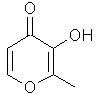
Maltol or 3-hydroxy-2-methyl-4-pyrone...C7H8O3
.............................
Although we have come to consider Ethylmaltol (see below) the standard "cotton candy" (candy floss) note of reference in perfumery, maltol is a naturally occuring chemical that can been found in chicory, cocoa, coffee, roasted malt, bread or even strawberry and which gives this spun caramelized effect we have come to associate with fair grounds.
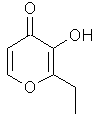
Ethyl Maltol or 3-hydroxy-2-ethyl-4-pyrone...C8H10O3 ..............................
Ethyl Maltol is the ethyl analog of Maltol, of course, but this time the molecule is synthesized in the lab and is not to be found in nature: hence the boosted effect; almost 500% more than simple maltol!
Smell Thierry Mugler's Angel, the trendsetter of ethylmaltol and patchouli orientals ~with a nod to childhood~ from 1992 and be prepared to be blown away by its potent spun sugar, cotton candy note!

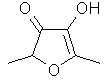
Furaneol(R) or 2,5-Dimethyl-4-hydroxy-3(2H)furanone ..C6H8O3
..........................
This is a molecule which was taught to samba from the craddle: it naturally contributes largely into the chemical make-up of several tropical fruit (guava, lychee, pineapple) as well as other less exotic ones (strawberry, raspberry, tomato). The fact that it is used in roasted products as well (such as corn tacos, roasted almonds, popped pop-corn or roasted coffee) contributes to its perception as a "roasting" note. I hypothesize that it's at the heart of Dior's Miss Dior Chérie, a composition based on the tension between strawberry and freshly cooked pop-corn.

Cyclotene or 3-Methyl-2-cyclopenten-2-ol-l-one ..C6H8O2
..........................
With Cyclotene we enter the maple section of notes: Although fenugreek solid extract is used to render a maple-suryp note (indeed it was the only extract source of caramel-maple notes till the discovery of these other ingredients), actual maple suryps are further aromatized with Cyclotene; thus creating the vivid association of the molecule's odour with our perception of how maple suryp smells like! Is it maple that smells of Cyclotene or Cyclotene that smells of maple? Naturally occuring in fenugreek seeds, it's also very common today in roasted sugary products such as coffee desserts, licorice sweets, desserts with roasted almonds and, apart from fenugreek seeds, it also occurs in cocoa and coffee.

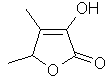
Sotolon or 4,5-Dimethyl-3-hydroxy-2(5H)-furanone..C6H8O3
..........................
Sotolon is the key ingredient in roasted fenugreek seed and brown sugar, which is as yummy a combination as any, hence its reference as "caramel furanone" or "sugar lactone" as well as "fenugreek lactone". When it's really concentrated, it takes on curry-like tonalities while on lower concentrations it can stay within the "caramelised sugar on the pan" range of odour.
But Sotolon also possesses notes that match boozy tonalities, as it's occuring in sake, rice wine, and botrytized wine. Remember the niche fragrance Botrytis by Ginestet, meant to reproduce the "noble rot" of a fungus on the Sauternes grapes? It's got Sotolon in it, blending the pain d' épices, candied fruits and honey notes into one seamless blend.
Although Sotolon is thousands of times more powerful than Cyclotene, the modern flavours industry is using the even more powerful maple furanone (one of the most potent flavor chemicals known to man) , this time for the enhancement of the flavour of soy sauce. Thankfully, this ingredient hasn't bombasted commercial fragrances yet, but who knows what the future holds.


Related reading on Perfume Shrine: Immortelle/Helichrysum: golden sunshine of the Med , Perfumery's Raw Materials

Ref: Leffingwell Photo of maple syrup by Martin Eager

Tuesday, April 5, 2011

Perfume and the Perfumed: When Icon & Fragrance Delightfully Clash

Imagine the jaws dropped when Christina Hendricks, the one of voluptuous bosom, retro colouring and glamorous role in Mad Men, the cult TV-series, revealed some of her favourite things on People magazine, naming a fragrance among them: The fragrance was Premier Figuier by L'Artisan Parfumeur, a fig fragrance. It's quite usual to think of perfume in the way of a glamour accessory meant to evoke a specific image, but how can this astound us when a perceived connotation of a specific fragrance is shattered by its actual use; especially when it is by someone famous which we envisioned a specific way. For many seasons fans of the series imagined Hendricks oozing sex-appeal in something that was come-hither and ripe of the seductress, in the context of a 1960s classy one, not withstanding.

It's an automatic reflex to think of fragrance as a very specific symbol of self, the most pliable perhaps of all, since it does not evolve neither a sanctimonious financial overlay (like a condo would), nor an extreme make-over. Spray and you're good to go; or so the thinking goes. After all, we have been told that a fragrance wardrobe should be our goal, fitting scent to time & place and to outfit, not to mention our mood.

What happened with the above scenario is that we had pegged Christina a certain way: the curvaceous glamour puss and we -more or less- refuse to believe that she is a living, breathing woman with tastes of her own who chooses an outdoorsy, intelligent scent that is reproducing something that is not meant specifically for seduction, but for one's self. It might have helped that we saw a shot of Christina as Joan Holloway (office manager of the advertising agency Sterling Cooper) in front of a mirror preening, applying lipstick, with an array of glamorous bottles in front of her, one of which was the seductive Shalimar by Guerlain in one of the stills from the TV-program. Premier Figuier has its own special sex appeal, but it lacks the edge that a certain mythos over the decades has given to Shalimar. We have come to associate the actress with the role of the sassy femme fatale, as if she is incarcerated in her DD-cup and her cinched waists, smart reply hanging on rouged lips. And yet, her style is not without substance. On the contrary. But like in many cases of projecting a certain image in olfactory terms, it's another example where the mold is broken and we raise an eyebrow in surprise.


I hear similar pronouncements all the time perusing some of my favourite perfume-discussing boards: "Jackie Kennedy Onassis was the epitome of elegance, it all fits she wore Joy and Jicky". (But not only!) "Maria Callas was so loyal to Chanel, she must have worn No.5, her style was so timeless." (We'll never know for sure though the hypothesis holds water) "I can picture a chypre perfume on Katharine Hepburn". (and yes, she scored one or two, but not only!).

In our above exercise, Peggy Olson would wear the cool, brainy chypre fragrance. "Keira Knightley must have an endless crate of Coco Mademoiselle, oh look here, she says she only wore men's scents before!" (absolutely not true). Madame Sarkozy, previously known as Carla Bruni, is an Italian aristocrat who modelled for a hobby, so it fits she would wear something with a pedigree of taste and quality. (voila, indeed!).

I had the easiest time while composing my Vetiver Series picturing each and every one of the vetiver fragrances featured on the visage of some male actor (even though they did not necessarily wear said fragrance in real life): smart and facially rugged Hugh Laurie, alluring and insinuating Jeremy Irons, straightfoward old-school Gerald Butler, virile and seemingly cocksure Russell Crowe, suave but enigmatic Ralph Fiennes. Was I guilty of free-associating thanks to no more than the persona they project? Most certainly.


To cut a long story short, celebrities choose what they choose for various reasons, one of the lesser or grudgingly admitted ones being that they are people like us with their own set of criteria, tastes, memories and dislikes. But try to take that out of our heads? Not so easy...

And on to YOU: Are you guilty of associating specific fragrances to specific people and why? Share your thoughts in the comments!

*Note on picture of Christina Hendricks as Joan in Mad Men bathroom scene in front of perfume display: The AMC photo is from Season 3, Episode 3: “Guy Walks Into an Advertising Agency”. The fragrances tray includes for sure Houbigant's Demi Jour, a Lauder bottle (same shape as the later Estee but it's probably Youth Dew) and Intimate by Revlon.

Christina Hendricks photos via wikimedia commons, Huffington Post and Haircutting in High Heels

Monday, April 4, 2011

L'Artisan Extrait de Songe/L'Ete en Douce: fragrance review

Essence of a dream, that is Extrait de songe, was the very poetic name of a limited edition “clean”perfume for summer 2005 by L’artisan Parfumeur. The latter lost a legal battle over the coveted name with Annick Goutal who had the name Songes (=dreams) copyrighted for her own, completely different, floriental composition. Hence the lovely Extrait de Songe became extinct... Later it was rechristened as L'Eté en Douce (playing on a French idiom, meaning "summer is sneaking up on you") and entered the L'Artisan portfolio as a re-issue.
However many perfume fans say the fragrance in either name smells quite close to another older L’artisan offering, one of the Moodswings coffret, Lazy Mood, developed by the same perfumer, Olivia Giacobetti. This got me thinking.

Laziness, boredom, dullness….all of these words bring to mind the languorous days of a really hot summer, when one isn’t energized enough to actively do anything except sleep. We had a long bout of this in the summer and am afraid we will get it again soon enough.
When I am talking hot, I am not talking Canada “hot”. Nor Germany “hot”. These are euphemisms. These are mere bleeps on the radar of hotness, never managing to register with me. (It’s actually my preferred weather: if only we had 28 degree Celsius half the year long...)
I am talking 39-40 degrees hell hot, all red and fiery; when your own skin is becoming revolting to you and you want to tear it apart with one swift gesture like an overzealous Russian waxer with steroid-enhanced arms; when hair sticks on your forehead inviting you to turn into a travesty of a skinhead; when sticky liquid oozes off your pores just by sitting around doing nothing. Yes, you’ve guessed it: I hate those moments with a passion.
The “noon devil” of the hermits of Egypt, which draws out every speck of physical and mental vitality, is my personal nemesis.

However it is a small comfort that Extrait de songe/L'Eté en Douce exists for providing the illusion of a clean, cool, white cotton sheet that can be wrapped all around one and provide some solace from the scorching sun. Sloth according to Kirkegaard is the source of all evil. Wordsworth described it as “wild dullness”. It is considered one of the seven deadly sins by the Catholic church. Hamlet refers to the world as “tiresome, plain and dull” which probably explains why he never lifts a hand to actually do anything except talk for the better part of the play.
Samuel Butler says that boredom is a kind of spiritual failure, since the person who lets himself to emote it is more despicable than boredom itself.
But is it so bad, really? I wonder…

Billy Collins, the poet, calls boredom paradise itself. “It’s the blessed absence of things that the world offers as interesting such as fashion, media, and other people, whom Sartre –let’s not forget- characterized as hell.”
Anton Chekhov also idealized boredom in many of his plays, like in Uncle Vania and Samuel Beckett’s “Waiting for Godot” remains without a doubt the manifesto of dullness, featuring characters that await for that bastard Godot who never makes an appearance and which proves boredom can be pro-active after all, because many had stood up and left the theatre from what I recall :-)) The New York author Richard Greenburg even wrote a book (titled “Take me out”) after a bout of boredom during one especially dull summer, during which he watched baseball matches on TV. Luckily I am not that desperate. Brenda Way, choreographer, likes to sit and think when stuck in a jammed highway: She believes it aids her involuntary voyage to creativity by using her unconscious powers at those precise moments.

Made by nose Olivia Giacobetti, who is famous for her light compositions that are like Winslow Homer paintings, Extrait de Songe/L'Eté en Douce is typically her style and seems very fit for such moments. It's an interpretation of freshness without acidulated, fusing or sparkling notes and it reminds me of the style that Jean Claude Ellena later explored in one of his "cologne" duo, called Eau de Gentiane Blanche. The two fragrances do not smell the same, but they share a similar sensibility and a generous smothering of ambrette seed.
Featuring an airy and totally linear formula, Extrait de Songe/L'Eté en Douce begins with linden and lots of "clean" orange blossom water, like the flower water used to sprinkle Mediterranean cookies with, segueing on to hay- like (coumarin?) and woody notes, it finishes off with a kiss of white musk and the bitterish ambrette like newly washed bed-clothes envelopping your showered body. It's all purity, all light! Uncomplicated, easy, soft, lastingly diaphanous, evoking the dew caressing grass in a field and on wild rose bushes, the freshness of lime trees and the warm scent of freshly cut hay; a fragrance that has no aspirations of creating discussion, but only of making you feel good about yourself! The whole projects at a white radiant frequency which must be as close to seraphic cool places as possible without actually hitting the bucket.

Whatever your camp is (and I suppose you still run a pulse if you're reading right now), Extrait de Songe/L'Eté en Douce manages to smell like it is the best thing to exonerate the bad and amplify the good aspects of boredom.

The original bottle of Extrait de Songe is a beautiful lavender blue degrade cylinder (the colour becomes more saturated on the bottom) with plain, silver sprayer, now a collector's item. The newer bottle under L'Eté en Douce follows the typical L'Artisan packaging with label in lavender blue.

Notes for L'Artisan Extrait de Songe/L'Eté en Douce:mint, rose, orange blossom and white musk

Please note: another fragrance by L'Artisan has just recently changed name, namely Vanille Absolument which used to be Havana Vanille (2009).

Inspired by a euro2day comment. Pic of kitten got sent to me by email, unaccredited. L'Ete en Douce bottle pic via duftarchiv.de

Sunday, April 3, 2011

L'Artisan Parfumeur Fleur d'Oranger 2011: It's Back!


One of the most elusive and revered orange blossom scents is the two-time wonder by L'Artisan Parfumeur called Fleur d'Oranger: the last 2007 edition was a tad different than the original from 2005, but hope died entirely when reserves even of that one dried up. But L'Artisan has had other plans it seems: Fleur d'Oranger (part of the Harvest Series, alongside the spectacular Iris Pallida and the hay-like Fleur de Narcisse) is back in 2011: This time in a normal bottle of 50ml/1.7oz instead of the big ones in the wooden crates like precious millesime wines. Information wants the re-issue a limited edition, although there is no specific mention on the actual bottle to indicate this is so. According to a sampler friend: "The composition is very similar to the previous two, maybe slightly less sweet comparing to the 2007 version". The current edition is much more sanely priced at 75€ .

It remains the subject of hypothesis whether the use of the typical bottle hints at an abandoning of the Harvest Series by the brand entirely. At any rate, the official L'Artisan site doesn't mention the series any more...

thanks to Elysium for bringing it to my attention

Saturday, April 2, 2011

Cacharel Loulou: fragrance review

When Cacharel Loulou first came out in 1987, there was a wonderful TV ad set to the romantic Pavane, Opus 50 by Gabriel Fauré and veiled in the mysterious bluish tones of the print ad. It featured a slip of a girl in a classic 20’s bob haircut dressed in a dark stretch dress (so Parisian at the time, very Azzedine Alaia!), swaying hurriedly through space on what seemed a film set, and when a voice called out “Loulou”, she turned to us –the viewers- replying “Oui, c’est moi” (i.e.yes, that’s me). It transported the Cacharel-trademark hazy contours and grainy shots of photographer Sarah Moon to the next level: a Lolitesque seduction. It has haunted me ever since...

The inspiration of Loulou by Cacharel: Loulou was meant to evoke the great film actress Louise Brooks and her Lulu role in the silent 1928 Pabst film Pandora’s Box (tamer than its title would hint at, but not by much considering). Louise Brooks has captured the imagination of discerning cinephiles ever since. Her trademark haircut (that actually recalls Cleopatra herself) has inspired many women and men alike. In fact Guido Crepax, the Italian sketch artist of “Valentina”, fashioned his notorious heroine of a vivid imagination and lush posterior attributes on her. The comic book had been turned into a RAI miniseries back in the late 80’s starring Demetra Hampton. The erotic TV-series was heavy in cultural referencing; indeed one episode was called ..."Lulu", reprising the Brooks character.

Loulou the Cacharel fragrance is almost forgotten today, although slightly less than those episodes, although it hasn’t been discontinued. In an age that pushes celebrity scents to an apotheosis, the natural urge of the perfume fanatic would be to turn to niche scents and/or classics from the distant past. Indeed this has been the case with many, as current literature on the subject indicates. That leaves many lovely perfumes of a more recent crop to the shade. Pity if you think about it. I had used the perfume for a while back, enjoying the wink in the eye it provided, the naiveté, the pure élan. It was perfection for those times!

The formula was composed by perfumer Jean Guichard, who is also responsible for Obsession (another 80’s hit), Eden (another forgotten Cacharel), and Deci Dela ( the delectable light chypre by Nina Ricci). Loulou bears the mark of the decade’s excess : lush and rich, it would seem completely out of place up until ten years ago when gourmands entered the scene. Somewhere between floral and oriental and with a similar feel to both Oscar de la Renta and Poison, Cacharel Loulou can also be viewed as a distant cousin of Guerlain's L’Heure Bleue. The sweet and a little melancholic heliotrope plus anise ties them together. The Cacharel fragrance opens on the characteristic note of cassis, a synthetically recreated berry base, quite sweet. This may become overwhelming on some, but the assistance of bergamot and aniseed manage to soften the blow of the top notes. Violet, mace and plum add their smooth nuances along with an armful of ylang-ylang, jasmine, marigold and a smidgen of tiare (that tropical flower of Tahiti), although one would be hard pressed to locate any of those individually, except for heliotrope perhaps which has a soft almondy scent, imparting a powdery aura along with the earthy orris: The feeling is almost retro, much like the whole ambience of the scent is after all. The fragrance lasts and lasts on the skin, suffused with musks and woods, with the insistence of tonka bean, a hay-like vanillic seed of a West African tree.

The bottle of Loulou looks best in the parfum or splash version (as depicted in the ad): a turquoise polygonal opaline that continues the house’s love affair with opaline (later to be reprised in green for Eden) topped with a dark red pointy stopper and garlanded with a burgundy red tassel : the contrast of colours is daring and unique, the concept vaguely inspired by Poison according to Michael Edwards. The Eau de parfum sprayer is sadly not as pretty.
To me Loulou will always remain the smell to match the young girl that had first caught my eye in the TV ads and myself back then : insouciant , oblivious to her own seductiveness. A wonderful fragrance, if rather sweet for everyday.


The commercial still produces a sigh of delightful and wistful reminiscence in me, like a dog who is sighing, her paws tucked in and her ears down at the completion of a tender, sad patting as if to part forever.

Photo of Demetra Hampton as Valentina via facebook. Loulou ad via Parfum de Pub. Louis Brooks in Pandora's Box via seraphicpress.com

Friday, April 1, 2011

Perfumery Materials: Neroli, Petit Grain, Orange Blossom, Bigarade

The Mediterranean basin could be described as one giant orangery during spring: the green trees, called bigaradiers, with their dense foliage of shiny leaves are seen sprouting small white blossoms; first, closed like Q-tips and then bursting into an orgy of fragrant flowers, emitting a sweet, yet delicate and fresh fragrance that travels long and far. These individual orangey trees belong in a unique order, bearing fruit still while at the same time blossoming! But you'd be hard-pressed to cut and eat that fruit; the orange-toned rind hides a very bitter flesh which is perfect however for proper marmelade or "spoon sweets". And they only turn their characteristic bright colour in the temperate Mediterranean climate: Spain, Greece, and also...California. Those growing in tropical climates, such as Florida or India or Ghana retain a yellow-greenish tinge.


The amazing tree which produces those wonders of nature is citrus aurantium var. amara (or bigaradia), commonly referred to as "bitter orange tree" (Also known as "Seville orange tree" due to the fact that the romantic city by the river is choke-full of them and because it was the centre of Moorish culture when the trees were first brought into the region from Arabia in the 9th century AD). Perfumers call it by another name, grosser but more accurate in terms of "giving": the pig of perfumery. Every part of this tree gives a lovely material.

The methods which produce different materials: neroli, orange blossom absolute, biagarade, petit-grain

David Seth Moltz, the nose behind D.S. & Durga, the Brooklyn-based perfume company, explains it well: Cold-pressing the fruit peel yields bigarade, the essential oil of the bitter orange; distilling the twigs gives you petitgrain (keep in mind that the same method gives petit-grain from other citrus trees such as lemon petit-grain, lime petit-grain etc); and the orange blossoms provide you with neroli (neroli comes from steam distillation of the flowers) while the same flowers can yield orange blossom absolute when treated with solvents to extract their essence. Distillation is usually carried out in such a way that 1 liter(1 kg) of distillation water (orange flower water) is obtained per 1 kilogram of charged orange flowers. This method incidentally, yields on the average about 1 gram of neroli oil.
That's not all, though: Distill the leaves, twigs and flowers together and you have "petitgrain sur le fleur." But it's still not over yet: Petitgrain water absolute or eau de brouts is the equivalent of orange flower water absolute and is obtained as a by-product from petitgrain bigarade oil. It enhances the 'naturalness' of several other fragrances, e.g. jasmine, neroli, ylang-ylang and gardenia.

"This one tree," Mr. Moltz explains, "gives you a range of citrus, wood, flower and all that lies in between—clean, fresh, dark, spicy." It is, in other words, a tree worthy of obsession! [1]


The differences in scent between the materials
Neroli has a sharper, more delicate aroma with a pleasantly bitter top note, a floral, herbal, green body and a floral, orange flower dry-out. It's lighter than the more overtly feminine orange blossom absolute which is more indolic and lusher, heavy and rich, warm, but also delicate and fresh, long-lasting odour, closely resembling the fragrance of fresh bitter orange blossoms. Its fragrance is not unlike that of jasmine, less intensely floral, but with a greater freshness. Petit grain is more bitter and has a masculine edge. And of course bigarade is the very flavour of morning marmelade.

List of fragrances to guide your nose through the raw materials

To experience bigarade the simplest means is to grab a jar of Bonne Maman marmelade and dip your nose and inhale: the sweetness cannot cut too much on the bitterness which leaves an almost sour aftertaste, resulting into an experience far removed from the more prosaic sweet orange or strawberry jam. Another, more perfume-oriented means would be to grab a bottle of Cologne Bigarade by Frederic Malle (composed by Jean Claude Ellena who excels into that sort of Mediterranean compositions) or his more concentrated and rubbery version with touches of cumin, Bigarade Concentree. Another alternative would be Creed's Citrus Bigarrade [sic].

Neroli has a romantic tale attached to its name: "In the 17th century, the princess of Nerola, Italy, used orange blossom to perfume her stationary, baths and, most famously, her gloves. As she gestured to her courtiers and lovers, a gentle wake of blossom must have trailed her hands. Now, neroli can be found in any number of perfumes, soaps and, according to myth, the secret recipe for Coca-Cola! It is the very essence of spring—that first bloom that promises sun and romance. And like romance, in the hands of a master perfumer, it can be heady or hesitating, sophisticated or innocent, sweet or dangerous. Mr. Moltz describes pure neroli as being "prim and proper." He likes to "dirty it up" with flowers that bring out neroli's wet and sexy vibe. [1] The major chemical components of neroli bigarade oil are: linalool, limonene, linalyl acetate, nerolidol, geraniol, and methyl anthranilate. Extraction of flowers with supercritical CO2 yields a neroli bigarade oil much richer in linalyl acetate (23%) than neroli oil obtained by water distillation. The content of methyl anthranilate (1%) is also significantly higher [2].
If you want to experience a soliflore neroli fragrance, try Annick Goutal's Néroli, a Parisian take on the Med idea . "The idea for Néroli was a warm wind blowing through a blooming orange grove," says Camille Goutal, the creative director after Annick's passing. "It was also inspired by a childhood memory: my uncle spent his holidays in Tunisia and would bring me back bouquets of orange flowers. Of course the main ingredient is the neroli, freshened by the petitgrain Paraguay (which is also tender and green) and petitgrain citronnier. The cypress and the galbanum bring a subtle woody note."
Chloé offers Eau de Fleurs Neroli for spring and summer, a fragrance which mixes an aromatic top with rosemary and clary sage with "clean" upbeat, contemporary notes of peony and white musk.

To get a good dosage of petit-grain, look no further than Miller Harris and Le Petit Grain. A unisex fragrance which brings on a garland of aromatics to boost the angular facets of the material, such as angelica root, tarragon, thyme and lavender. Refreshing due to its briskness, but not without its own depths thanks to patchouli and moss.


For orange blossom the choices are endless. You can check out several on our "Orange Blossom series" classified according to mood. But to recap some of the more characteristic:

Perhaps the loveliest and truest soliflore orange blossom rendition is L'Artisan's original Fleur d'Oranger harvest edition. Fresh, crystalline, projecting with needle-point precision but never too sharp, its melodious song is like a kiss on the lips from someone one had long longed for. The major drawback is it cost an arm & a leg and it was a one-time wonder, as the subsequent reissue from a few seasons ago is a little bit different.

Jo Malone's Orange Blossom cologne takes on a crisp but feminine interpretation of the flowers of the bitter orange tree: the composition is flanked by lemongrass and clementine oils on top (so that the fragrance retains a live-like freshness) and by lily and lilac notes on the bottom to soften and feminise it.

On the contrary Prada's Infusion de Fleurs d'Oranger [full review here] apart from a brief departure of orange flowers and neroli segues on into soapier arpegios with Serenolide (a synthetic musk), therefore being a less representative candidate.

Le Labo is one brand which features orange blossom at the heart of three of their fragrances: Fleur D'Oranger 27, (feminine with jasmine and sunny bergamot); Neroli 36, a playful mix of watermelon, salt, rose, mandarin and musk; and in Tubereuse 40, vibrating with the dynamism of tuberose, cedar, mimosa and petitgrain.

But perhaps the most majestic orange blossom absolute of them all is Fleurs D'Oranger by Serge Lutens. Far from being an orange blossom soliflore as its name suggests, this is a fragrance as beguiling as Salome dancing the dance of the seven veils. Upon each revelation, the anticipation heightens till the next one. The initial stage is one of soft orange blossom, in the words of Serge, the "strengthening of a breeze", hidding the more mysterious, invested interests in the background, emerging slowly like shadows from an orchard which suns itself somewhere off the Mediterranean coast. The accomplice in this is tuberose and its strange, wicked angularity creeps in beneath the shadows. But despite the fragrance's lushness and drama, it dries down to a delicate sweetness that resembles honeyed woman's skin; discreet and very, very sensual.

Last but not least the etymology is also interesting and quite mixed-up: The word orange (EN and FR), naranja (ES), arancia (IT) are all derived from the Persian naranj which in the contrary means bitter orange ("νεράτζι" i.e. nerantzi, in Greek), the place where the bitter variety of the tree comes from. The Iranians call oranges 'portoghal' which resembles the Greek word for sweet oranges, πορτοκάλι; to my knowledge, only in Greek among European languages has the Persian distinction been maintained. But how come the Greek call orange the ...Portugeuse fruit? (That's what the name means) It's because the Portugeuse traders brought sweet oranges into the Mediterranean basin from China centuries after the bitter oranges were brought to these shores...


[1] Ref. Wall Street Journal
[2]Ref. White Lotus Aromatics


Collage photo via beauty maverick. Photo of bitter orange tree by CorinthianGulf/flickr

Guerlain Aqua Allegoria Flora Nerolia: fragrance review

There is nothing more early April-like than the smell of bitter orange trees blossoming, their waxy white petals infiltrating the glossy green of the leaves and some fruit still hanging from the branches, like a reminder of what has been already accomplished.


Guerlain captured the ethereal vapors of steam off these delicate, ravishing blossoms and married them to a pre-emptying summer jasmine (middle-ground indolic) and the faint whiff of cool frankincense burning inside a Greek Orthodox church preparing for the country's most devout celebration: Easter. The citrusy aspects of frankincense compliment the fruitier aspects of neroli. Musk in the form of synthetic Cashmeran is anchoring the effect on skin. Guerlain's Flora Nerolia (a part of the original line up in the Aqua Allegoria line in 2000 composed by perfumer Mathilde Laurent) is like a snapshot of late Lent in Greece and for that reason is absolutely precious to me.

Notes for Guerlain Aqua Allegoria Flora Nerolia:
neroli and petitgrain (citrus leaves & twigs) in the top, and jasmine and orange blossom in the heart. Frankincense for the base.

Lamentably discontinued (much like the rest of the original line-up composed by Mathilde Laurent) with the exception of Herba Fresca and Pamplune, Flora Nerolia can be sometimes found on Ebay.
The history, notes and short reviews of all the Guerlain Aqua Allegoria scents can be found on this link. 

Background on the Photo (by anomieus/flickr):
As far back as the time of the dowager empress Wilhelmine Amalie an orangery garden was laid out at Schönbrunn which included a hothouse for overwintering bitter orange trees. In 1754 Franz I Stephan instigated the building of the Orangery by Nicola Pacassi, probably to designs by Nicolas Jadot. One hundred and eighty-nine metres long and ten metres wide, the Schönbrunn Orangery is one of the two largest Baroque orangeries in the world, the other being at Versailles. The south façade is articulated by an alternating series of large and smaller apertures with rusticated pilasters decorated with masks. The interior has a rhythmic sequence of shallow vaults and is heated by a hypocaust system. The Orangery served not only as the winter quarters for citrus trees and other potted plants but was also a winter garden used for imperial court festivities. Joseph II was especially fond of holding celebrations in the Orangery with festively-decorated banqueting tables, ranks of flowering plants and illuminations in the citrus trees. During a winter festivity in 1786 Mozart conducted his Singspiel "The Impresario" here.
The rear part of the Orangery is still used in its original function, while the front section, which has been renovated, is used for events such as the Schönbrunn Palace Concert series.

Thursday, March 31, 2011

Tom Ford Tobacco Vanille: fragrance review

As the cooler months draw to an end I have a faint pang of nostalgia on fragrances which will be rather difficult to bring out in the heat of summer due to either their density that feels like a warm blanket that obscures light when playing on the bed as a kid, or due to their characteristic warm bouquet that feels at home only beside curduroy jackets and black & tan riding boots. Tom Ford's Private Blend Tobacco Vanille checks both boxes in question and, if the female reception of this rather unisex vanilla fragrance is any indication, some more figurative boxes as well. With my anticipation for Lavender Palm building, I returned to this deep and sweet scent for a re-introduction now that woolens are slowly coming off.

Part of the luxurious Private Blend by Tom Ford line which comprises 12 fragrances (like Champaca Absolute, Noir de Noir, Tuscan Leather, Japon Noir, Arabian Wood, Bois Marocain, Italian Cypress, Azure Lime, Neroli Portofino, Oud Wood, and the now discontinued Velvet Gardenia etc), Tobacco Vanille as its name suggests is an oriental; suave, smoldering and quite smooth. Its salient characteristic is the unguous fall of a rich tobacco bouquet into the creamy, cocoa butter-like vanilla with unexpected accents of dried fruits. The sweetness is not accountable to the vanilla though, but to the honey note that good pipe tobacco often displays.

Indeed for a while one loses the tobacco pouch for the honeyed-drenched cream pudding being served. But the two do co-exist and the dried fruits accents is reminiscent of the Lutensian school of thought, easily. Or of Coco by Chanel, the original spicy one, with its inclusion of a cocoa note amidst it all; perhaps of the mood of Dior's Hypnotic Poison (the poison scaled down considerably in Tom's version, like in the Hypnotic Poison Eau Sensuelle), or, if one is being mean, of rootbeer float. I seem to detect an almond note too, which is a classic but delicious pairing with vanillas. Indeed Tobacco Vanille takes on gourmand aspects that go beyond a simple cookie vanilla, built on complex notes that end up smelling like two voices singing in musical thirds; harmony... Up close, sniffing on the wrist, Tobacco Vanille can take an ash-tray note, while a little space between it and one's nose reveals a more sultry sillage that is rich and tempting. This is one reason why this is a perfume that I do not recommend spraying on one's clothes; I suspect the result by the end of the day might get a little stale.

Nevertheless, I can't seem to personally enthuse on Tobacco Vanille too much, for what is worth, due to its rather excessive sweetness. I prefer my vanillas drier, somewhat more powdery, and my tobacco given a palm-on-sweaty-thigh-rolling-it vibe reminiscent of Havana and Habanita. But that's just me, don't let it stop you. Tobacco Vanille is one of Tom Ford's most popular fragrances and a must-try for vanilla or tobacco lovers everywhere. Plus, it's marketed as a unisex (you have to enjoy sweet scents on men, though, to appreciate it) and it lasts very long.

Notes for Tom Ford Tobacco Vanille:
Spicy note, aromatic note, tobacco, tonka bean, tobacco flower, tobacco leaf, dried fruit, vanilla, cocoa, tree sap.

Private Blend
Tobacco Vanille by Tom Ford comes as Eau de Parfum (1.7oz, 3.4oz and 8.3oz sizes), available at select points of sale such as Harrods, Neiman Marcus, Nordstorm.

Picture of Demi Moore smoking a cigar, originally printed on Cigar Aficionado Magazine.

50 Cent Drops 50 Scent: Perfume Parody

You always wanted some ghetto-blasting perfume to just break through all the noses held up high and the pretencious blurb on "serious" publications? Well, here we are providing some laughs as well courtesy of 50 Cent and his humorous take on Scent...
50 Scent emits "the dangerous aroma of a freshly fired 9 milimeter semiautomatic handgun", the bling-tastic bouquet of a burlap sack stuffed with $100 bills" plus the sine qua non "audaciously naughty whiff of skanky ghetto gold-digger". To be slathered on "those unsightly drive-by scars to make old wounds sizzle with brutish sensuality". Hilarious!
A project fit for Dish-au-Four (the hip new French recipe!) no doubt.


Click the pic to enlarge.

Credit: Humor Gazette

Wednesday, March 30, 2011

Laboratorio Olfattivo Esvedra: new fragrance by Pierre Guillaume

News fresh from Esxence, Italy, where the artistic exhibition for niche perfumery is taking place as we speak: Talented perfumer Pierre Gauillaume, well known for his "numerical" personal line Parfumerie Générale (established in 2002), and author of the Huitième Art project, created a new opus, called Esvedra, under the Laboratorio Olfattivo aegis.(An Italian niche line, promisingly established in 2009 with the motto “emotional experiences that come to life through our sense of smell").


The name Esvedra derives from within the geographical confines of the Mediterranean sea: Es Vedrà is a Balearic island a mere 2 km off the western coast of the cosmopolitan isle of Ibiza, in the area of Cala d'Hort. The island is a nature reserve, comprised almost solely of limestone, yet considered of a significant magnetic energy in folk lore. Let's not forget that for centuries the western edge of the Mediterranean was considered the end of the world and that sea tales concerning its many maritime wonders captured the imaginations of poets (producing the Odyssey, the Aeneid) and common folk alike.

The olfactory focus is vetiver, but Pierre proposes a new take, as he says: "It's an irregular vetiver, fractalized which expresses a magnetic green facet, sensual and luminous with accents of lemon petit-grain and coriander leaves". He envisioned it as a perfume that proposes a different structure than the classical top-middle-base notes pyramid, as all of the ingredients are truly contained within the centre of the composition. You could call it linear I guess or core-focused.

Notes for Laborattorio Olfattivo Esvedra: Nevenolide, vetiver, petit-grain from lemon trees, coriander leaves, musk.

Esvedra will be available in Eau de Parfum concentration (12%) in 100ml bottles soon. To buy when available watch this space.

Es Vedra picture at sunset via wikimedia commons
thanks to extrait.it for the in situ reportage

This Month's Popular Posts on Perfume Shrine